
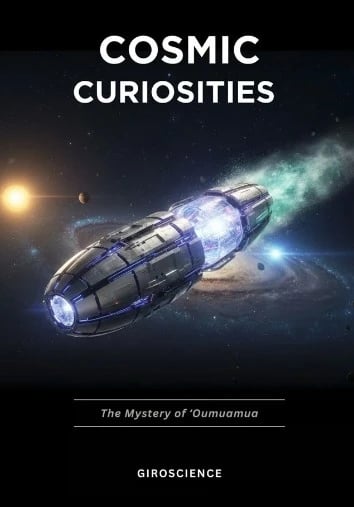
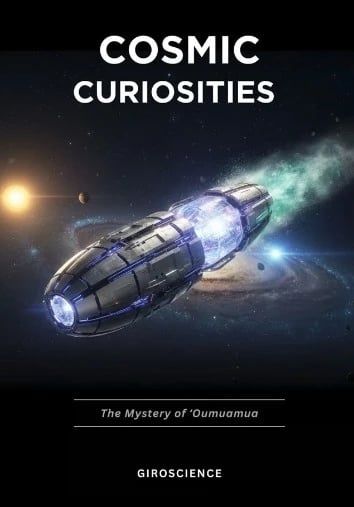
Introduction : on October 19, 2017, the Pan-STARRS1 telescope in Hawaii captured a faint, fast-moving speck. Detected by astronomer Robert Weryk, it was initially thought to be a common comet. But as the data poured in, it became clear: this was no ordinary traveler.
The enigma of the "interstellar scout"
What did the global mobilization of telescopes (VLT, Hubble) reveal about this silent visitor?
Extreme geometry: a "pancake" or "cigar" shape with a 10:1 aspect ratio, tumbling chaotically in a way that suggests a violent past collision.
Hyperbolic path: with an orbital eccentricity of 1.20, 'Oumuamua was mathematically proven to be unbound by the sun's gravity.
Record-breaking speed: it reached a peak of 196,000 mph (315,000 km/h) during its slingshot around the sun.
The unseen push: a scientific conundrum
The most baffling discovery was its non-gravitational acceleration. 'Oumuamua sped up as it left the Sun, yet it showed no visible coma or outgassing jets.
This led to the leading 2023 theory: the release of molecular hydrogen entrapped within a water ice matrix, an invisible propulsion system fueled by millions of years of cosmic rays.
Frequently Asked Questions (FAQ)
Q: is 'Oumuamua an alien spacecraft?
A: while its shape and acceleration are unusual, most scientists focus on natural explanations like hydrogen sublimation. However, the "artifact" hypothesis remains a topic of intense scientific debate.
Q: why did 'Oumuamua accelerate without a tail?
A: its acceleration was likely caused by the release of molecular hydrogen trapped within its ice matrix, a process that doesn't produce a visible dust cloud.
Q: where is 'Oumuamua now?
A: it is currently past the orbit of Neptune, returning to the interstellar void at a speed of 58,900 mph.
Download the investigation report
As part of the Giroscience mission to make complex physics accessible, we are offering our full 10-page research report on a "pay what you want" basis.
You can download it for free, or choose to support our independent scientific visualization work with a contribution of your choice.
What you will discover in this e-book:
Visual reconstruction: high-resolution graphics of the visitor’s trajectory.
The 2023 hydrogen theory: a deep dive into the latest scientific consensus.
Interstellar origins: analysis of its journey from the Lyra constellation.
Your support, even small, helps us stay ad-free and continue exploring the mysteries of the universe through science and art.
Explore Further
Subatomic explorer -> Master the quantum scale. From quarks to the fundamental forces of nature.
Giroscience Magazine -> The Quark-Gluon Plasma and the origins of matter.