
Executive Summary
Tesla does not manufacture aircraft. Despite viral social media posts, misleading YouTube thumbnails, and the occasional breathless headline declaring that Elon Musk has launched a "Tesla plane," the company remains firmly a ground-based electric vehicle and energy storage business. Yet the confusion is not entirely baseless. Tesla's battery technology, motor engineering, and energy management systems are precisely the building blocks that the aviation industry desperately needs to electrify flight. More concretely, Tesla made a significant investment in Archer Aviation, an eVTOL (electric vertical takeoff and landing) startup, creating a real but often misrepresented connection between the Tesla brand and airborne transport. This article separates fact from fiction, traces why the "Tesla aircraft" myth spread so effectively, examines what the Archer partnership actually involves, and situates the whole story within the larger arc of electric aviation. By the end, you will understand not only what Tesla does not do but also why the underlying question matters enormously for the future of sustainable transport.
Table of Contents
1. The Tesla Aircraft Myth: Where It Comes From
The claim that Tesla makes or is about to release an aircraft surfaces with remarkable regularity on social media platforms. Search for "tesla aircraft" and you will encounter a cascade of thumbnail images showing sleek winged vehicles emblazoned with the Tesla logo, dramatic captions promising supersonic travel, and comment sections divided between believers and skeptics. The search volume for "tesla aircraft" sits at around 8,100 queries per month, which tells you something important: a lot of people genuinely want to know whether this is real.
The myth draws its energy from several converging sources. First, Elon Musk's personal brand is so closely entangled with futuristic technology that many people assume anything audacious in transportation must involve him or his companies. Musk has spoken publicly about tunnels, rockets, electric trucks, brain-computer interfaces, and solar roofs. An aircraft, in that context, feels like an obvious next step rather than a category error. Second, the genuine investment Tesla made in Archer Aviation created a factual kernel around which speculation could crystallize. The investment was real; the extrapolation to "Tesla is building a plane" was not.
Third, and perhaps most important, content farms and engagement-hungry YouTube channels have discovered that "Tesla Aircraft" thumbnails generate clicks at an extraordinary rate. The combination of a trusted brand name, aspirational technology, and implied secrecy ("What Elon doesn't want you to know") is algorithmically irresistible. The content rarely survives scrutiny, but it does not need to. By the time a viewer realizes the video is pure speculation or outright fabrication, the view has already been counted.
Understanding why misinformation spreads is not merely an academic exercise. The aviation industry is undergoing a genuine and significant transformation, and the noise generated by Tesla aircraft rumors makes it harder for people to find accurate information about real developments. Separating the myth from the genuine story serves everyone who cares about where transportation technology is heading. For a deeper dive into how physics constrains what aircraft can actually do, our analysis of space propulsion physics and future tech provides relevant grounding.
2. What Tesla Actually Makes
Tesla, Inc. is an American multinational corporation founded in 2003 and headquartered in Austin, Texas. Its core business lines are electric vehicles, battery energy storage systems, and solar energy products. The vehicle lineup includes the Model S, Model 3, Model X, Model Y, Cybertruck, and the Semi. None of these are aircraft, and none are designed to leave the ground through aerodynamic lift.
The company's engineering strengths are formidable but specific. Tesla has become the world's most capable manufacturer of large-format lithium-ion and lithium iron phosphate battery packs. Its 4680 cylindrical cell format, introduced as a major manufacturing innovation, offers higher energy density, reduced production cost per kilowatt-hour, and improved thermal management compared to earlier cell geometries. These are properties that matter enormously for any application where energy storage weight is critical, which includes aviation.
Tesla's motor technology is similarly advanced. The company uses permanent magnet synchronous reluctance motors in its vehicles, achieving efficiency figures that most combustion engine manufacturers cannot approach. The inverter electronics that govern power delivery are designed and manufactured in-house, giving Tesla an unusual degree of vertical integration that allows for rapid iteration.
What Tesla does not have is aerospace certification experience, airframe engineering capability, avionics expertise, or any regulatory relationship with the Federal Aviation Administration as an aircraft manufacturer. These are not trivial gaps. The aviation certification process is one of the most rigorous in any engineering domain, and it typically takes decades for a new entrant to build the institutional knowledge required to navigate it successfully. Tesla has made no public moves to acquire or build those capabilities, which is consistent with a company that has no aircraft program.
3. The Archer Aviation Partnership Explained
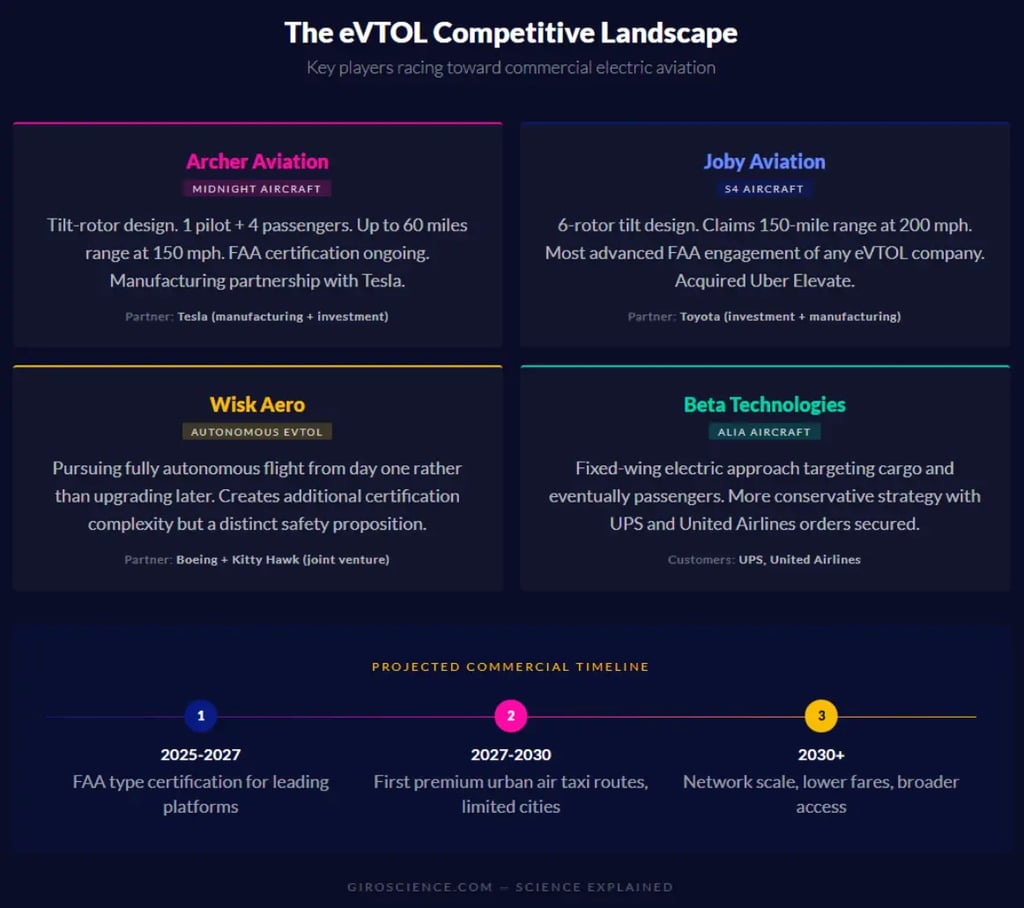
The factual basis for the Tesla-aviation connection is a manufacturing and supply agreement between Tesla and Archer Aviation, announced in 2021. Archer is a California-based startup developing an eVTOL aircraft called Midnight, designed to carry one pilot and four passengers on urban air mobility routes of up to 60 miles at speeds of up to 150 miles per hour.
The Tesla connection operates on two levels. First, Tesla made an equity investment in Archer, meaning Tesla holds a financial stake in the company's success. Second, and more substantively, the two companies entered a manufacturing collaboration agreement under which Tesla provides manufacturing expertise and potentially supply chain resources to help Archer produce its aircraft more efficiently and at scale. This reflects a broader pattern in Silicon Valley where successful hardware companies are asked to share production knowledge with adjacent industries facing similar challenges.
It is worth being precise about what this partnership is not. Tesla is not designing the Midnight aircraft. Tesla is not certifying the aircraft. Tesla's name does not appear on the fuselage. The collaboration is an industrial services and investment relationship, not a co-branding or co-manufacturing arrangement in the sense that casual reporting often implies. Archer retains full design authority and carries the regulatory burden of achieving FAA type certification.
For Archer, the Tesla relationship represents genuine value. Manufacturing eVTOL aircraft at commercial scale is an unsolved problem. The tolerances required, the battery integration complexity, and the quality control demands are closer to automotive production than to traditional aerospace assembly. Tesla's production expertise, earned through years of scaling up Model 3 and Model Y manufacturing, is directly applicable to those challenges. The partnership is therefore genuinely meaningful for Archer's commercial prospects, even if it says nothing about Tesla entering the aviation market itself. You can read more about how cutting-edge physics underlies modern propulsion in our overview of fastest combat aircraft and military aviation speed.
4. How eVTOL Technology Works
Electric vertical takeoff and landing aircraft represent a genuinely novel category of flying machine, distinct from both conventional fixed-wing aircraft and traditional helicopters. Understanding how they work clarifies both why they are exciting and why they are difficult.
An eVTOL aircraft typically uses multiple electrically driven rotors arranged around an airframe. During takeoff and landing, all rotors operate in a configuration similar to a large multicopter drone, providing direct vertical lift. Once airborne and transitioning to cruise flight, many eVTOL designs tilt some or all of their rotors to a forward-facing position, using the lift generated by fixed wings or canards to carry the aircraft's weight while the rotors provide thrust. This hybrid approach, called a tilt-rotor or vectored thrust design, allows efficient cruising that would be impossible if the vehicle relied on rotor lift for the entire flight.
The electric powertrain is central to why this configuration is feasible. Multiple independent electric motors, each drawing from a shared battery pack, allow a level of redundancy that would be mechanically impractical with internal combustion engines. If one motor fails, the flight control software redistributes power to the remaining motors and adjusts rotor speeds within milliseconds, maintaining stable flight. This distributed redundancy is a genuine safety advantage and is one of the core arguments eVTOL manufacturers make when engaging with aviation regulators.
The physics of hovering are, however, extremely energy-intensive. Lift during hover requires continuous power proportional to the aircraft's weight, unlike fixed-wing flight where speed converts to lift at relatively low ongoing energy cost. This is why eVTOL aircraft are almost universally designed for short-haul urban routes rather than long-distance travel. The energy density of current lithium-ion batteries simply cannot sustain the power demands of hover and low-speed flight over distances that would compete with ground transportation for intercity journeys.
The flight control systems on eVTOL aircraft are sophisticated software platforms running on redundant computing hardware. Sensor fusion algorithms integrate data from inertial measurement units, GPS, barometric sensors, and radar or lidar altimeters to maintain stable flight across varying atmospheric conditions. The pilot interface is deliberately simplified, with much of the moment-to-moment stabilization handled autonomously, reducing the workload to something closer to driving than to piloting a conventional helicopter.
5. Electric Aviation's Real Challenges
The challenges facing electric aviation are substantial and largely rooted in physics rather than engineering immaturity. Understanding them is essential to forming realistic expectations about what electric flight will and will not accomplish over the next decade.
The most fundamental constraint is energy density. Aviation-grade jet fuel contains roughly 12,000 watt-hours of chemical energy per kilogram. The best current lithium-ion cells achieve approximately 300 watt-hours per kilogram at the cell level, and a complete battery system including packaging, thermal management, and electronics typically delivers 150 to 200 watt-hours per kilogram. This means an aircraft battery pack stores roughly 1 to 2 percent of the energy per unit mass that jet fuel provides. For short urban hops of 20 to 60 miles, this is workable. For transatlantic flight, it is not remotely competitive, and this will not change unless battery chemistry undergoes a revolutionary rather than evolutionary improvement.
Certification timelines present a second major challenge. The FAA's process for granting type certificates to new aircraft categories is deliberate and conservative, for good reasons. Every novel design feature must be demonstrated to be safe under a comprehensive range of conditions, failure modes, and environmental stresses. For eVTOL, which involves novel propulsion architectures, novel flight control approaches, and operation in airspace shared with other aircraft and people on the ground, the certification path is unprecedented. Most industry analysts now expect leading eVTOL platforms to achieve type certification no earlier than 2025 to 2027, with commercial passenger services following some years after that.
Infrastructure is a third constraint that receives less attention than it deserves. eVTOL aircraft require dedicated takeoff and landing pads, ground power infrastructure for rapid recharging, maintenance facilities, and air traffic management integration. Building this infrastructure in urban environments involves real estate negotiations, city planning approvals, noise impact studies, and capital investment that no single company can provide unilaterally. The business model for urban air mobility depends on a coordinated buildout that is still in very early stages.
6. Tesla's Battery Technology and Its Aviation Potential
Tesla's battery technology, while developed for ground vehicles, is more relevant to aviation than any other mature consumer product battery platform. The reasons are instructive.
Tesla has invested more heavily than almost any other organization in the science of large-format lithium-ion cell manufacturing. The 4680 cell format, developed at Gigafactory Texas, achieves its performance through a combination of a tabless electrode design that reduces internal resistance and heat generation, a dry electrode coating process that eliminates toxic solvents and reduces manufacturing floor area, and increased cell volume that improves the ratio of active material to packaging overhead. The cumulative effect is a cell that offers better energy density, faster charge acceptance, and longer cycle life than the 18650 and 2170 format cells that preceded it.
For aviation applications, each of these properties matters. Higher energy density extends range. Faster charge acceptance reduces ground turnaround time between flights, which is critical to the economics of urban air taxi operations. Longer cycle life reduces the frequency of expensive battery pack replacements. Tesla has not stated publicly that it intends to supply cells to aviation customers, but the properties of its cells align closely with what the eVTOL industry requires.
The thermal management expertise Tesla has accumulated is also relevant. Aviation batteries face more severe thermal challenges than automotive batteries because power delivery rates during takeoff are very high, flight cycles are frequent, and the consequences of thermal runaway at altitude are more severe than they are on the ground. Tesla's battery management systems, which monitor individual cell voltages and temperatures and actively balance charge states across thousands of cells simultaneously, represent a form of embedded intelligence that transfers well to aviation battery pack design.
The broader insight here is that Tesla's technology portfolio, even without any direct aviation program, is shaping the trajectory of electric flight by establishing what is achievable in high-performance battery systems. When Archer and its competitors specify battery requirements for their aircraft, they are targeting performance levels that Tesla's automotive program has demonstrated are manufacturable at scale.
7. The Competitive eVTOL Landscape
The eVTOL sector has attracted substantial investment and a diverse competitive field. Understanding the landscape contextualizes where Archer, and by association Tesla, sits within the broader industry.
Joby Aviation is widely considered the furthest along in certification, having acquired Uber Elevate's aerial ridesharing division and accumulated significant FAA engagement. Joby's S4 aircraft uses a tilt-rotor configuration with six rotors and claims a range of 150 miles at 200 miles per hour, performance figures that, if validated in service, would be genuinely transformative for urban mobility. The company has a manufacturing partnership with Toyota, a parallel to Archer's relationship with Tesla.
Lilium, the German eVTOL startup, pursued a different technical approach using electric jet engines integrated into the wings rather than exposed rotors. The company faced financial difficulties in 2024, went through insolvency proceedings, and was subsequently restructured, illustrating the financial risks in a sector that requires enormous capital before generating any revenue.
Wisk Aero, a joint venture between Boeing and Kitty Hawk, is developing autonomous eVTOL aircraft designed to fly without a human pilot aboard. Wisk's approach prioritizes full autonomy from the outset rather than treating it as a future upgrade, which creates both a distinct value proposition and additional certification complexity.
Beta Technologies, a Vermont-based startup, has taken a more conservative fixed-wing electric aircraft approach and has secured orders from United Parcel Service and United Airlines. Beta's ALIA aircraft is designed primarily for cargo and eventually passenger short-haul routes, with a business model less dependent on the urban air taxi market than most of its peers.
The competitive dynamics of this landscape are important context for evaluating Archer's position. Being partially supported by Tesla's manufacturing expertise is a genuine advantage, but it does not guarantee commercial success in a market where multiple well-funded competitors are simultaneously racing toward the same certification milestones.
Realistic projections for electric aviation's near-term future look quite different from the viral "Tesla aircraft" content that circulates on social media, but they are no less interesting for being grounded in engineering reality.
The first commercial phase, likely spanning 2026 through 2030, will almost certainly be dominated by short-haul eVTOL operations in high-density urban environments. Routes of 10 to 60 miles connecting city centers to major airports, or linking wealthy suburban communities to business districts, represent the use cases where eVTOL economics can work within current battery constraints. Fares will initially be expensive, reflecting the high capital cost of aircraft and infrastructure, but operators will target premium commuters and business travelers willing to pay significant premiums for time savings.
Battery technology will continue improving, though more slowly than optimistic projections suggest. Solid-state batteries, which replace the liquid electrolyte in conventional cells with a solid material, promise substantially higher energy density and improved safety. Several manufacturers, including QuantumScape (in which Volkswagen holds a significant stake), are advancing solid-state technology toward automotive and potentially aviation applications. However, manufacturing solid-state cells at scale has proven extremely difficult, and commercial deployment for aviation remains at minimum five to ten years away.
Regulatory frameworks will evolve to accommodate new vehicle categories and operating concepts. The FAA's MOSAIC rule and various advanced air mobility integration initiatives signal a genuine institutional commitment to enabling eVTOL commercial operations, but the pace is inherently constrained by the deliberate nature of aviation safety oversight. International harmonization, particularly with the European Union Aviation Safety Agency, will be necessary before global commercial networks can develop.
The longer-term horizon, beyond 2035, may see electric propulsion extend to regional aircraft routes of 200 to 500 miles as battery energy density improves. Hybrid-electric configurations, combining battery power for high-demand takeoff phases with fuel cells or range-extending generators for cruise, may bridge the gap between today's short-range eVTOL and a fully electric medium-range future. The science of UAP physics and AI touches on some of the propulsion concepts that may eventually inform aerospace innovation at longer timeframes.
Common Mistakes to Avoid
When researching Tesla and electric aviation, several common errors recur that lead people significantly astray.
The most widespread mistake is conflating Elon Musk's various companies. Musk is associated with Tesla, SpaceX, Neuralink, The Boring Company, and X (formerly Twitter). SpaceX is an aerospace company with extraordinary capabilities, but it builds rockets, not aircraft, and it is entirely separate from Tesla both legally and operationally. Claims about Tesla aircraft sometimes actually refer to SpaceX projects that have been mislabeled, adding another layer of confusion.
A second mistake is treating manufacturing partnership agreements as product collaboration. When Tesla agreed to support Archer's manufacturing operations, this created a business services relationship, not a joint product development effort. The Midnight aircraft is an Archer product. Tesla's involvement does not make it a Tesla aircraft any more than a supplier relationship between Boeing and its thousands of parts vendors makes every commercial jet a Boeing-branded component manufacturer's product.
Third, many people underestimate how far current battery technology is from enabling meaningful competition with jet fuel for medium or long-haul aviation. The energy density gap is not a temporary engineering problem that will be solved in three to five years. It represents a fundamental constraint of electrochemistry that will require genuinely novel battery chemistries, not incremental improvements, to substantially close.
Finally, be skeptical of specific performance claims attached to the "tesla aircraft" concept in social media content. Claims about supersonic electric flight, flight ranges of thousands of miles, or production timelines of "as soon as next year" are not grounded in any public information from Tesla, Archer, or any credible aviation industry source.
FAQ
1. Does Tesla make aircraft?
No. Tesla does not manufacture, design, or sell any aircraft. The company's products are limited to ground-based electric vehicles (Model S, Model 3, Model X, Model Y, Cybertruck, Semi), battery energy storage systems (Powerwall, Megapack), and solar energy products. Tesla has no aircraft program, no FAA type certificate applications pending, and no publicly announced intention to enter the aviation market. The confusion stems primarily from Tesla's investment in and manufacturing partnership with Archer Aviation, an eVTOL startup, combined with widespread social media misinformation that uses the Tesla name for engagement purposes. If you have seen videos or articles claiming Tesla has unveiled or is about to release an aircraft, those claims are not supported by any credible source.
2. What is the Tesla and Archer Aviation partnership?
In 2021, Tesla made an equity investment in Archer Aviation and the two companies entered a manufacturing collaboration agreement. Under this arrangement, Tesla provides manufacturing expertise and potentially supply chain resources to help Archer scale production of its Midnight eVTOL aircraft. This is a business services and investment relationship, not a co-branding or joint design arrangement. Archer retains full design authority over the Midnight aircraft, and Tesla's name does not appear on the vehicle. The partnership is valuable to Archer because the challenges of manufacturing eVTOL aircraft at commercial scale share significant similarities with automotive mass production, an area where Tesla has extensive proven expertise. For Tesla, the investment represents a financial bet on the growth of the urban air mobility market without requiring Tesla to build or certify aviation products itself.
3. What is eVTOL technology and why does it matter?
eVTOL stands for electric vertical takeoff and landing. It refers to a new category of aircraft that uses electrically powered rotors to take off and land without requiring a runway, combined with efficient fixed-wing or rotor-based cruise flight once airborne. eVTOL aircraft matter because they could enable a form of urban air mobility that is much quieter, cleaner, and potentially cheaper than helicopter transportation, opening up aerial commuting to a much broader population. The technology is enabled by advances in electric motors, battery energy density, and flight control software that have collectively made multi-rotor electric aircraft feasible at passenger-carrying scales. The vision is for networks of small aircraft operating between vertiports in cities, reducing ground traffic congestion and dramatically shortening commute times for high-demand routes.
4. Could Tesla's battery technology be used in aircraft?
Yes, in principle, and this is one of the more legitimate connections between Tesla and aviation. Tesla's 4680 cell format offers higher energy density, faster charge rates, and longer cycle life than most commercially available alternatives, properties that are directly relevant to aviation applications. Tesla has not publicly announced plans to supply cells to aviation customers, but the technical properties of its battery systems align well with what eVTOL manufacturers require. Several eVTOL companies source cells from manufacturers who supply the automotive industry, and as Tesla's cell production scales up, it would not be surprising to see aerospace customers exploring supply relationships. Whether Tesla chooses to pursue such relationships is a business decision that has not been made public.
5. Is a Tesla supersonic aircraft real or fake?
The "Tesla supersonic aircraft" is not real. No such product exists, has been announced, or is reportedly in development. The concept appears entirely in viral social media content designed to generate clicks through a combination of brand recognition, technological aspiration, and implied secrecy. Supersonic flight requires radically different engineering from subsonic aircraft, involves enormous fuel consumption (or in electric terms, energy consumption), and presents aerodynamic, materials science, and sonic boom challenges that are completely unrelated to Tesla's engineering domains. The search term "tesla supersonic aircraft" generates about 10 searches per month, and those searches invariably lead to either fictional content or fact-checking articles explaining why no such thing exists.
6. When will electric passenger aircraft be commercially available?
Leading eVTOL companies expect to achieve FAA type certification for passenger-carrying aircraft in the 2025 to 2027 timeframe, with commercial operations beginning within a year or two of certification for pioneering routes. Joby Aviation and Archer Aviation are among the furthest advanced in the certification process. However, these initial services will be limited in scope, serving specific high-demand corridors at premium prices. Broader commercial availability, with the scale and pricing needed to be genuinely accessible to typical passengers, will take longer, likely into the 2030s. The timeline depends on certification progress, battery technology advancement, infrastructure development, and the financial sustainability of eVTOL operators through their pre-revenue phases, all of which carry substantial uncertainty.
7. What happened with the "Tesla TU-144 aircraft" claims?
The Tupolev Tu-144 was a Soviet supersonic passenger aircraft that flew commercially briefly in the 1970s, the USSR's counterpart to the Anglo-French Concorde. There is no connection whatsoever between Tesla and the Tu-144. The search term "tesla tu-144 aircraft" appears to originate from content farms combining two disparate aviation-related search terms to capture traffic from multiple keyword clusters simultaneously. This is a straightforward example of search engine optimization combined with misinformation, and it illustrates the extent to which the "tesla aircraft" information ecosystem is shaped by engagement optimization rather than factual reporting.
8. How does the "Tesla plane fact check" hold up?
The short fact check is: Tesla does not make a plane, has never announced a plane, and has no publicly known aircraft program. The viral content claiming otherwise relies on a combination of the Tesla-Archer investment relationship (real but misrepresented), Elon Musk's broad association with futuristic technology (real but non-specific), and algorithmically optimized misinformation that uses the Tesla brand to maximize engagement. The detailed fact check reveals that essentially every specific claim made in "Tesla aircraft" viral content, including release dates, performance specifications, and government partnerships, has no verifiable factual basis. When evaluating any claim about a novel Tesla product, the most reliable sources are Tesla's official investor communications, SEC filings, and press releases. None of these mention an aircraft program.
Conclusion
The story of "Tesla aircraft" is, at its core, a story about how misinformation spreads in the age of algorithmic content distribution, and about how a real but limited business relationship can be inflated beyond recognition by the demand for exciting content. Tesla does not make aircraft. The company's genuine aviation connection, a manufacturing partnership and investment in Archer Aviation's eVTOL program, is interesting and worth understanding, but it is categorically different from the claims that generate millions of views on social media.
What is genuinely exciting about Tesla's relationship to aviation is more subtle than any rumored aircraft launch: Tesla's battery technology and manufacturing expertise are contributing to an industry-wide acceleration of electric aviation development. The challenges that eVTOL companies face, from energy density constraints to certification complexity to infrastructure buildout, are real and substantial, but they are not insurmountable. The 2020s will likely see the first tentative steps toward commercial eVTOL operations, and the technology will improve steadily from there.
Understanding the actual state of electric aviation, rather than the mythologized version, is useful for anyone who wants to think clearly about the future of transportation, sustainable energy, or the intersection of Silicon Valley and legacy industries. The truth is complex, uncertain, and more interesting than the viral alternative.
Sources
Archer Aviation. (2021). Archer Aviation and Tesla Manufacturing Agreement. https://www.archer.com/news
Federal Aviation Administration. (2024). Advanced Air Mobility (AAM) Implementation Plan. https://www.faa.gov/aam
Joby Aviation. (2025). S4 Aircraft Type Certification Progress Report. https://www.jobyaviation.com/news/