
Executive Summary
The fastest combat aircraft ever built is the SR-71 Blackbird, achieving speeds of Mach 3.3 (2,193 mph or 3,529 km/h) - more than three times the speed of sound. Following closely is the Soviet MiG-25 Foxbat at Mach 3.2, and the experimental X-15 rocket plane that reached Mach 6.7, though not classified as a traditional combat aircraft.
Modern fighter jets like the F-22 Raptor (Mach 2.25) and Su-57 (Mach 2.0) prioritize stealth and agility over pure speed, reflecting a strategic shift in air combat. This guide examines the top 10 fastest military aircraft, explores how speed evolved across fighter generations, and analyzes how artificial intelligence is reshaping the future of combat aviation - including autonomous fighters and 6th generation concepts that may redefine aerial warfare by 2030.
Understanding combat aircraft speed requires examining thrust-to-weight ratios, aerodynamic design, materials science advances covered in our guide to advanced materials, and the physics of supersonic flight explained through kinematic equations. As military aviation enters the AI era, speed remains crucial but now integrates with sensor fusion, networked warfare, and autonomous decision-making systems.
Table of Contents
What is the Fastest Combat Aircraft?
The title of fastest combat aircraft belongs to the Lockheed SR-71 Blackbird, a reconnaissance plane that first flew in 1964 and remained operational until 1998. The SR-71 achieved a maximum speed of Mach 3.3 (2,193 mph or 3,529 km/h) at altitudes exceeding 85,000 feet. Despite being designed primarily for reconnaissance rather than direct combat, the SR-71's defensive strategy relied entirely on outrunning any threat - including missiles and interceptors.
The Blackbird's speed came from several engineering innovations. Twin Pratt & Whitney J58 turbojet engines generated 32,500 pounds of thrust each. The aircraft's titanium airframe could withstand temperatures exceeding 900°F during sustained Mach 3+ flight. Fuel expansion at high temperatures required the SR-71 to leak fuel on the ground, which sealed only after the airframe heated and expanded during flight. This counterintuitive design demonstrates how extreme speed demands radical engineering solutions.
For traditional fighter aircraft designed for air-to-air combat, the MiG-25 Foxbat holds the speed record at Mach 3.2 (2,115 mph or 3,402 km/h). Developed by the Soviet Union in the 1960s as a high-altitude interceptor, the MiG-25 could reach its maximum speed only briefly before risking engine damage. Sustained flight typically occurred at Mach 2.8. Over 1,100 MiG-25s were built, and several nations still operate variants today.
Modern combat aircraft rarely achieve these extreme speeds. The latest fighters like the F-35 Lightning II reach only Mach 1.6, while the F-22 Raptor tops out at Mach 2.25. This apparent regression reflects changing priorities - stealth, sensor integration, network connectivity, and agility now matter more than pure speed. Contemporary air combat occurs at subsonic speeds during maneuvering, with missiles providing the kinetic advantage that raw aircraft speed once delivered.
Speed measurements in aviation use Mach numbers, representing multiples of the speed of sound. Mach 1 equals approximately 767 mph (1,235 km/h) at sea level, though this varies with temperature and altitude. The physics governing these speeds involves principles detailed in our kinematic equations physics guide, particularly regarding acceleration, velocity, and the forces acting on supersonic aircraft.
Fastest Fighter Jets by Country
Global military aviation power concentrates in a handful of nations capable of designing, building, and operating high-performance combat aircraft. Examining each nation's fastest fighters reveals strategic priorities and technological capabilities.
United States
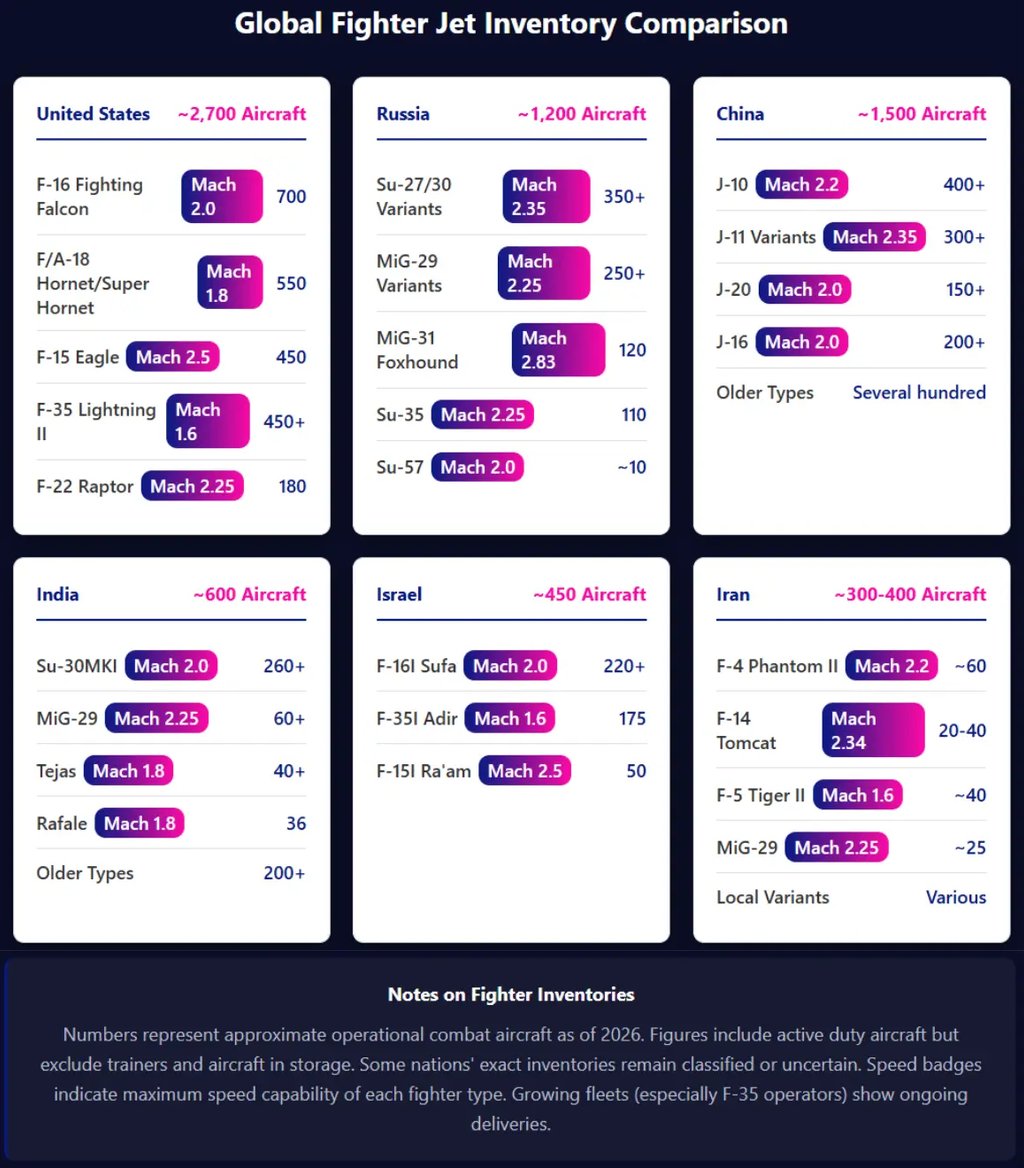
The U.S. operates the world's most technologically advanced fighter fleet, though maximum speeds have decreased with fifth-generation aircraft. The F-22 Raptor (Mach 2.25) represents the fastest operational American fighter, followed by legacy F-15 Eagles (Mach 2.5) still in service. The Navy's F/A-18E/F Super Hornet reaches Mach 1.8, while the newest F-35 Lightning II achieves Mach 1.6.
America's fighter fleet totals approximately 2,700 aircraft across the Air Force, Navy, and Marine Corps. This includes roughly 180 F-22s, 400+ F-35s (growing rapidly), 450 F-15s, 700 F-16s, and 550 F/A-18s. The emphasis on stealth and sensor fusion over raw speed reflects U.S. military doctrine prioritizing information dominance and long-range engagement.
Russia
Russia's fastest operational fighter is the MiG-31BM interceptor (Mach 2.5), designed specifically for high-speed, high-altitude interception of cruise missiles and bombers. The Su-35 (Mach 2.25) serves as Russia's most capable multi-role fighter until sufficient Su-57 fifth-generation fighters enter service. The Su-57 reportedly reaches Mach 2.0, though exact performance specifications remain classified.
Russia operates approximately 1,200 combat aircraft, including 120 MiG-31s, 110 Su-35s, fewer than 10 Su-57s (in limited production), 350+ Su-27/30 variants, and 250+ MiG-29 variants. Modernization programs upgrade older aircraft with new avionics, weapons, and engines, extending service lives while new production focuses on fifth-generation platforms.
China
China's People's Liberation Army Air Force operates the fastest-growing fighter fleet globally. The J-20 fifth-generation fighter reaches approximately Mach 2.0, comparable to the F-22 and Su-57. China's J-11 (a licensed/unlicensed copy of the Su-27) achieves Mach 2.35, while the J-10 multi-role fighter tops out at Mach 2.2.
Exact Chinese fighter numbers remain uncertain, but estimates suggest 1,500+ modern fighters including 150+ J-20s, 300+ J-11 variants, 400+ J-10s, and several hundred older designs. China produces fighters domestically at increasing rates, with indigenous engines replacing Russian imports in newer aircraft.
India
India operates a diverse fighter fleet combining Russian, French, and indigenous designs. The Russian-built Su-30MKI (Mach 2.0) forms the backbone, with 260+ aircraft in service. France's Rafale (Mach 1.8) entered Indian service in 2020, with 36 on order. India's indigenous Tejas light fighter reaches Mach 1.8, with over 40 delivered so far.
Total Indian Air Force strength includes approximately 600 combat aircraft, though many older types require replacement. The mix of suppliers reflects India's non-aligned strategy but creates maintenance and interoperability challenges.
Israel
Israel operates one of the world's most experienced air forces despite relatively small numbers. The Israeli Air Force flies approximately 175 F-35I Adir fighters (Mach 1.6), making it the largest F-35 operator outside the United States. Israel also maintains 220+ F-16I Sufa fighters (Mach 2.0) and approximately 50 F-15I Ra'am fighters (Mach 2.5).
Israeli fighters see regular combat, unlike most air forces. This operational experience drives continuous upgrades and unique modifications not found in other nations' fleets.
Iran
Iran's fighter fleet consists largely of pre-1979 revolution purchases, making accurate assessment difficult. The fastest Iranian fighters are approximately 20-40 operational F-14 Tomcats (Mach 2.34), though exact numbers and readiness status remain unknown. Iran also operates F-4 Phantom IIs (Mach 2.2), F-5 Tiger IIs (Mach 1.6), and locally modified versions of these aircraft.
Sanctions prevent Iran from purchasing modern fighters, forcing reliance on domestic upgrades and Chinese/Russian technology transfers. Some analysts estimate Iran operates 300-400 combat aircraft total, though many are non-operational due to parts shortages.
Other Notable Operators
Saudi Arabia operates 230+ combat aircraft including F-15SA Eagles (Mach 2.5) and Eurofighter Typhoons (Mach 2.0). Japan flies 200+ F-15J Eagles (Mach 2.5) and is acquiring F-35A/Bs. South Korea operates 60 F-15K Slam Eagles (Mach 2.5) and 150+ F-16s, with 40 F-35As delivered. The United Kingdom's Royal Air Force flies Eurofighter Typhoons (Mach 2.0) and is transitioning to F-35B carriers-capable variants.
Understanding global fighter distributions helps contextualize air power balance and explains why certain nations invest in speed while others prioritize stealth or numbers. The chemistry of jet fuel combustion and propulsion systems, covered in our molar mass calculations guide, applies equally to American, Russian, and Chinese fighters despite different design philosophies.
AI and Autonomous Combat Aircraft
Artificial intelligence is reshaping combat aviation more fundamentally than any technology since the jet engine. Modern fighters integrate AI for sensor fusion, threat assessment, and autonomous operation, while next-generation systems will feature AI-controlled wingmen and potentially fully autonomous combat aircraft.
Current AI Applications in Fighter Aircraft
The F-35 Lightning II demonstrates how AI enhances human pilots. Its Autonomic Logistics Information System (ALIS) uses machine learning to predict maintenance needs before failures occur, analyzing thousands of data points from sensors throughout the aircraft. The F-35's sensor fusion software processes inputs from radar, infrared sensors, electronic warfare systems, and data links, presenting pilots with a single integrated tactical picture rather than raw sensor data.
This AI-driven sensor fusion provides enormous advantages. In tests, F-35 pilots engage threats before opponents detect them, often destroying multiple targets before enemy fighters know they're under attack. The AI identifies threats, suggests tactics, and can even autonomously employ electronic warfare countermeasures without pilot input. However, final weapons employment decisions remain with human pilots - current AI assists but doesn't replace human judgment.
The F-22 Raptor, despite entering service in 2005, receives continuous AI upgrades. Recent modifications added machine learning algorithms that optimize radar search patterns, reducing the time needed to find and track threats. The system learns from every engagement, improving performance over the aircraft's lifetime.
Loyal Wingman Programs
Several nations are developing unmanned combat aerial vehicles (UCAVs) designed to fly alongside manned fighters under AI control. The U.S. Air Force's Skyborg program aims to produce affordable, expendable drones that can perform various missions while controlled by AI or human operators. The Kratos XQ-58 Valkyrie demonstrator flew successfully in 2019, showcasing beyond-visual-range missions, electronic warfare, and even air-to-air combat capabilities.
Australia's Boeing Airpower Teaming System (also called Loyal Wingman) completed flight testing in 2021. These 38-foot-long drones can fly up to 2,000 miles, carrying sensors or weapons while networked with manned fighters. The AI controller handles navigation, formation flying, and threat response, with human operators providing high-level mission direction.
Russia's Okhotnik (Hunter) UCAV flew in formation with a Su-57 fighter in 2020, demonstrating similar loyal wingman concepts. China reportedly operates similar systems, though details remain classified. These programs share common features - AI handles tactical-level decisions while humans provide strategic oversight.
Advantages of AI-Controlled Aircraft
Autonomous fighters offer several advantages over manned platforms. They can sustain G-forces exceeding 15 Gs indefinitely, far beyond human tolerance. This enables maneuvers impossible for manned aircraft, particularly high-speed direction changes. AI reaction times measure in milliseconds, compared to hundreds of milliseconds for human pilots - critical during close-range combat when microseconds determine survival.
Cost provides another advantage. Removing the pilot eliminates life support systems, ejection seats, and the armored cockpit, reducing weight and complexity. The Valkyrie costs approximately $3 million each, compared to $80 million for an F-35. This economics enables new tactics - sending swarms of cheap UCAVs against expensive enemy fighters forces impossible choices. Shoot down three $3 million drones with three $1 million missiles? The math favors the attacker.
Expendability changes mission planning. Manned aircraft avoid high-risk missions due to crew safety concerns. Unmanned platforms can accept losses that would be unthinkable for crewed aircraft. Early raid suppression, flying through denied airspace, or drawing enemy fire become viable tactics when aircraft losses don't mean pilot deaths.
Challenges and Limitations
AI-controlled fighters face significant challenges. Communications jamming can sever the link between drones and human controllers, forcing full autonomy or mission abort. Current AI struggles with unexpected situations that human pilots handle intuitively. Weather, equipment malfunctions, or novel enemy tactics can confuse AI systems trained on historical data.
Ethical concerns complicate fully autonomous weapons. Should AI decide when to kill? Most nations maintain policies requiring human approval for weapons release, but combat tempos may eventually force pure AI decision-making. The speed of future battles may exceed human comprehension - when AI dogfighting occurs at hypersonic speeds, humans cannot intervene meaningfully.
Adversary AI creates an arms race dynamic. If one side deploys superior AI, others must match or exceed it. This could lead to unstable situations where AI systems engage each other faster than human operators can understand or control. Science fiction scenarios of "AI deciding to attack" seem unlikely, but accidents, miscalculations, or AI behavior diverging from programmer intentions could trigger unintended escalation.
Sixth-Generation Fighters and Beyond
The United States Air Force's Next Generation Air Dominance (NGAD) program explicitly includes AI as a core capability. The program envisions a family of systems - some manned, some unmanned - operating together through AI-enabled networking. The manned platform might coordinate four to six loyal wingman drones, with AI handling formation flying, threat response, and weapons employment under human oversight.
Specifications remain classified, but industry statements suggest NGAD will include optional manning - capable of flying with or without pilots depending on mission requirements. This flexibility enables both high-risk autonomous missions and situations requiring human judgment. Speed requirements are unclear, with some sources suggesting Mach 3+ capability while others emphasize subsonic stealth and endurance.
Advanced materials play a crucial role in these systems. Thermal management for high-speed flight requires materials covered in our advanced materials innovation guide, while propulsion systems utilize chemistry principles explained in our stoichiometry article. The integration of AI, advanced materials, and revolutionary propulsion could produce fighters as different from the F-22 as the F-22 was from World War II aircraft.
The Human Role
Despite AI advances, humans will likely remain central to combat aviation for decades. Military leaders resist fully autonomous weapons for ethical, legal, and practical reasons. AI excels at pattern recognition, optimization, and rapid calculation, but humans provide creativity, moral judgment, and the ability to understand strategic context.
The optimal approach combines AI and human strengths. AI handles sensor processing, threat assessment, and tactical maneuvers. Humans provide strategic direction, rules of engagement interpretation, and final authorization for weapons employment. This teaming approach leverages both artificial and human intelligence, producing capabilities exceeding either alone.
Future pilots will transition from stick-and-rudder flying to mission command, directing AI wingmen and managing information flows. Training will emphasize systems management, data analysis, and strategic thinking rather than pure flying skills. Some compare this to the shift from sail to steam - early steamship captains needed different skills than sailing ship masters, but human judgment remained essential.