
Stimuli are detectable changes in the environment or within an organism that trigger measurable responses. This comprehensive guide presents 57 concrete examples organized across five sensory modalities (visual, auditory, tactile, chemical, cognitive) and two origins (external, internal). Modern applications include AI-powered health monitoring systems that detect subtle stimulus-response changes through voice biomarkers and wearable sensors, achieving diagnostic accuracies exceeding 90% for conditions like Parkinson's disease and cognitive decline.
In this article:
50+ stimuli examples across six major categories
External versus internal stimulus classifications
AI detection methods for health monitoring applications
Real-world case studies in elderly care and disease detection
Practical applications in clinical and research settings
What Are Stimuli Examples?
Stimuli examples demonstrate how detectable environmental or internal changes trigger specific responses across biological systems. A stimulus can be as simple as light hitting the retina (triggering neural signals that produce vision) or as complex as a social situation (activating multiple cognitive and emotional processes simultaneously). Understanding concrete examples clarifies the abstract definition and reveals how organisms continuously process thousands of stimuli to navigate their environment and maintain homeostasis.
The most fundamental stimuli examples include unconditioned stimuli that automatically trigger innate responses without learning. Food presented to a hungry animal triggers salivation through hardwired neural circuits connecting gustatory receptors to salivary glands. Pain from tissue damage triggers withdrawal reflexes through spinal cord pathways that bypass conscious processing, enabling rapid protective responses. Loud unexpected sounds trigger startle responses through brainstem circuits that prepare the body for potential threats.
Conditioned stimuli acquire response-eliciting properties through associative learning, as demonstrated in Pavlov's classic experiments. A neutral stimulus like a bell becomes a conditioned stimulus when repeatedly paired with food (the unconditioned stimulus). After sufficient pairings, the bell alone triggers salivation despite having no inherent relationship to food. This principle extends beyond laboratory settings to everyday experiences where previously neutral stimuli acquire emotional or behavioral significance through association with biologically meaningful events.
Discriminative stimuli signal when particular behaviors will produce rewards or punishments, guiding adaptive responding across changing environmental contexts. A green traffic light signals that driving forward will be safe and rewarded with progress toward a destination. An "Open" sign on a restaurant signals that entering will be rewarded with service. These contextual cues enable flexible behavior by indicating when specific actions are appropriate versus inappropriate.
Modern neuroscience recognizes that stimulus processing involves complex multi-stage transformations rather than simple input-output connections. Sensory transduction converts physical energy (electromagnetic radiation, mechanical pressure, chemical concentrations) into neural signals. These signals undergo extensive processing through hierarchical brain networks that extract features, compare inputs to predictions, integrate information across modalities, and generate contextually appropriate responses. Understanding this processing reveals why identical stimuli can produce different responses depending on internal states, prior experiences, and current goals.
The following sections present 57 specific examples organized by sensory modality and origin, demonstrating the breadth of stimuli that organisms process continuously. Each example includes the physical properties of the stimulus, the sensory receptors involved, typical responses produced, and relevant applications in research or clinical settings.
Visual Stimuli Examples
Visual stimuli encompass electromagnetic radiation between approximately 380-750 nanometers wavelength that activates photoreceptors in the retina. These stimuli demonstrate remarkable diversity in their physical properties (wavelength, intensity, spatial frequency, temporal dynamics) and biological significance (survival-relevant objects, social signals, aesthetic qualities).
Natural Light Sources
Sunlight serves as the primary visual stimulus for diurnal organisms, providing broad-spectrum illumination that enables object recognition, spatial navigation, and circadian rhythm entrainment. The human visual system detects sunlight intensities ranging from starlight (10^-6 cd/m²) to direct sunlight (10^5 cd/m²), demonstrating a dynamic range exceeding 10 orders of magnitude. Specialized retinal ganglion cells containing melanopsin photopigment detect blue-enriched daylight to synchronize circadian clocks in the suprachiasmatic nucleus, independently of conscious vision.
Moonlight provides reduced-intensity illumination that triggers scotopic (rod-mediated) vision in nocturnal and crepuscular species. Rod photoreceptors achieve single-photon sensitivity through biochemical amplification cascades, enabling navigation and foraging during night hours when cone-mediated color vision is ineffective.
Bioluminescence from organisms like fireflies produces species-specific temporal patterns serving as mating signals. The temporal frequency and duration of light flashes constitute discriminative stimuli that females use to identify conspecific males, demonstrating how stimulus timing conveys biologically critical information.
Artificial Light Sources
LED displays on smartphones and computers emit blue-enriched light (450-480 nm peak wavelength) that suppresses melatonin secretion when viewed during evening hours, disrupting circadian rhythms and sleep onset. This demonstrates unintended consequences when artificial stimuli override evolved biological mechanisms.
Traffic signals use color-coded lights as discriminative stimuli indicating when specific behaviors (stopping, proceeding, preparing to stop) are appropriate. The standardized red-yellow-green sequence enables rapid, automated responding once the associations are learned.
Laser pointers produce coherent, monochromatic light beams that create small, high-contrast spots triggering strong orienting responses and prey-chase behaviors in cats and other predators. The rapid movement of the bright spot mimics prey motion patterns, demonstrating how stimulus features (small size, high contrast, rapid motion) engage species-specific action patterns.
Biological Visual Stimuli
Facial expressions constitute complex visual stimuli encoding emotional states through configural patterns of muscle contractions. The human amygdala responds preferentially to fearful faces within 100 milliseconds of stimulus onset, demonstrating rapid, specialized processing of survival-relevant social signals.
Eye gaze direction serves as a powerful social stimulus triggering joint attention and theory-of-mind processes. Direct eye contact activates reward circuits and autonomic arousal, while averted gaze triggers spatial orienting to the gazed-at location.
Body postures communicate intentions, emotions, and physical states through spatial configurations of body parts. Threatening postures (expanded chest, raised arms) trigger defensive responses through visual pathways connecting superior colliculus to periaqueductal gray, enabling rapid threat detection.
Abstract Visual Patterns
Optical illusions like the Müller-Lyer illusion demonstrate how stimulus context alters perception through top-down processing mechanisms. Two identical-length lines appear different when terminated with inward- versus outward-pointing arrows, revealing that perception reflects active construction rather than passive reception of stimulus features.
Symmetry in visual patterns triggers preferences across species, potentially reflecting evolved detection mechanisms for healthy mates (bilateral symmetry signals developmental stability) or nutritious food sources (radial symmetry in flowers signals nectar availability).
Motion patterns such as biological motion (point-light displays of human walking) activate specialized neural circuits in superior temporal sulcus that extract socially relevant information from minimal visual cues, demonstrating domain-specific stimulus processing.
Auditory Stimuli Examples
Auditory stimuli consist of pressure waves between approximately 20-20,000 Hz frequency that activate mechanoreceptors (hair cells) in the cochlea. These stimuli encode information through temporal patterns, frequency content, intensity levels, and spatial locations that support communication, environmental monitoring, and music perception.
Speech Sounds
Phonemes are minimal sound units that distinguish word meanings across languages. The acoustic properties distinguishing /ba/ from /pa/ involve a 20-40 millisecond difference in voice onset time (time between consonant release and vocal cord vibration). This demonstrates how precise temporal stimulus features enable categorical perception that supports rapid speech comprehension.
Prosody (pitch contours, stress patterns, rhythm) modulates emotional meaning independently of word content. A statement like "You're here" can communicate joy, surprise, anger, or sarcasm depending on pitch trajectory and stress placement, demonstrating multi-level stimulus encoding.
Infant-directed speech uses exaggerated pitch contours and simplified phonetic patterns that capture infant attention and facilitate language learning. The acoustic properties of infant-directed speech constitute age-appropriate stimuli optimized for developing auditory systems.
Environmental Sounds
Alarm signals like sirens use high-intensity, rapid frequency modulation to capture attention and trigger orienting responses. The temporal pattern (rising and falling pitch) resists habituation more effectively than steady tones, demonstrating optimal stimulus design for behavioral control.
Natural soundscapes including birdsong, flowing water, and wind through trees produce complex acoustic patterns that reduce physiological stress markers (cortisol, blood pressure, heart rate variability) when presented to urban-dwelling humans, suggesting evolved preferences for ancestral acoustic environments.
Thunder produces low-frequency (<100 Hz), high-intensity acoustic stimuli that trigger startle responses and fear conditioning. The temporal relationship between lightning (visual stimulus) and thunder (auditory stimulus delayed by sound propagation) enables distance estimation and appropriate defensive responses.
Musical Stimuli
Rhythmic patterns entrain motor circuits, triggering synchronized movement across individuals (dancing, marching, clapping). The coupling between auditory rhythms and motor output demonstrates bidirectional stimulus-response relationships.
Dissonant intervals (frequency ratios like 15:16 creating roughness perception) produce aversive responses across cultures, potentially reflecting cochlear mechanics that generate neural interference patterns from closely-spaced frequencies.
Melodic contours (pitch trajectories over time) activate reward circuits when conforming to learned statistical regularities from musical exposure, demonstrating how stimulus expectations shape emotional responses.
Social Auditory Stimuli
Laughter triggers positive emotional responses and facilitates social bonding through acoustic features (breathy quality, rhythmic structure, frequency range) that distinguish genuine from posed laughter. The contagious nature of laughter demonstrates automatic social stimulus processing.
Crying in infants produces urgent, aversive responses in caregivers through acoustic features (fundamental frequency around 500 Hz, rapid rise time, high intensity) that evolved to capture attention and trigger caregiving behaviors.
Vocal pitch encodes social dominance and attractiveness, with lower fundamental frequencies associated with higher testosterone levels and perceived dominance in males. This demonstrates how stimulus features convey biologically relevant social information.
Temporal Auditory Patterns
Beat perception emerges from repeating temporal patterns every 500-800 milliseconds (corresponding to walking pace), triggering automatic movement synchronization and temporal prediction mechanisms.
Acoustic startle reflex involves rapid (<50 milliseconds) defensive responses to sudden, intense sounds, mediated by brainstem circuits bypassing cortical processing. Habituation to repeated sounds demonstrates plasticity in stimulus-response pathways.
Gap detection abilities (detecting silent intervals <10 milliseconds between sounds) enable phoneme discrimination and support temporal processing theories of language disorders.
Tactile Stimuli Examples
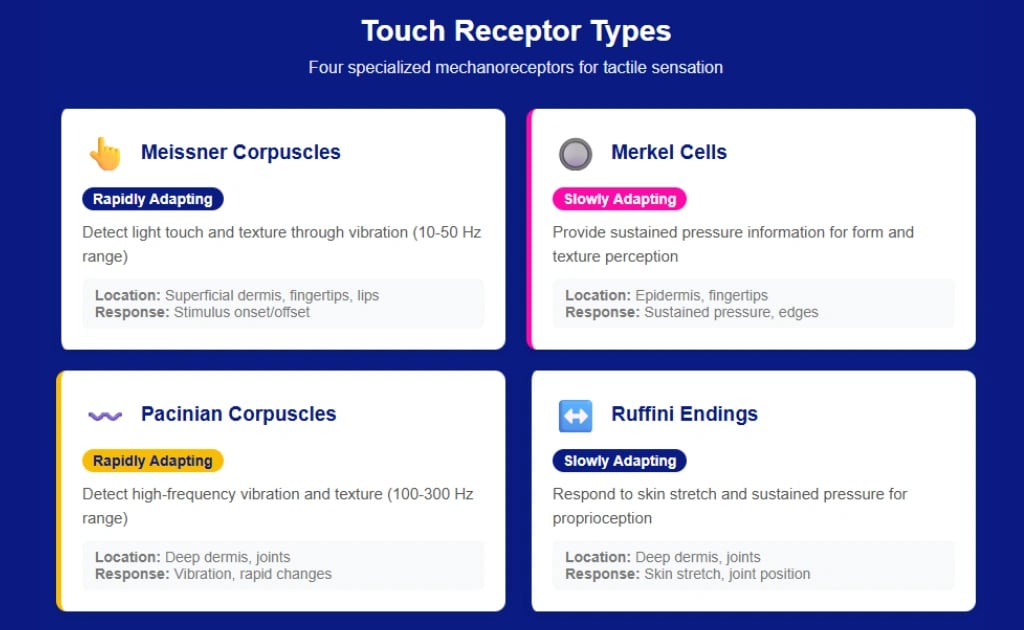
Tactile stimuli activate mechanoreceptors in skin, providing information about object properties (texture, shape, temperature, compliance), social touch (affiliative contact, threat), and body position (proprioception, kinesthesia). Different receptor types respond to distinct stimulus features, enabling rich somatosensory perception.
Mechanical Pressure
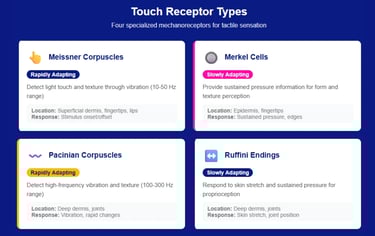
Light touch activates rapidly-adapting Meissner corpuscles (frequency range 10-50 Hz) that detect stimulus onset and offset while habituating to sustained pressure. This enables detection of objects contacting skin while filtering constant clothing pressure.
Deep pressure stimulates slowly-adapting Merkel cells and Ruffini endings that maintain sustained responses during continued pressure, providing information about object weight and grip force requirements.
Vibration at different frequencies activates specialized receptors: Meissner corpuscles (10-50 Hz), Pacinian corpuscles (100-300 Hz), enabling texture discrimination through active touch (exploratory finger movements generating vibration patterns).
Temperature Stimuli
Warm stimuli (>32°C) activate TRPV channels in thermoreceptors, triggering peripheral vasodilation and sweating when temperatures exceed neutral skin temperature (approximately 32°C). Extreme heat (>43°C) activates nociceptors producing pain sensations.
Cold stimuli (<32°C) activate TRPM8 channels, triggering peripheral vasoconstriction and shivering when core temperature regulation is threatened. The paradoxical "hot" sensation from temperatures below 0°C demonstrates complex central processing of temperature information.
Thermal gradients (spatial temperature variation) enable texture discrimination through differential heat conduction properties of materials, supplementing mechanoreceptor information during haptic exploration.
Pain Stimuli
Acute pain from sharp objects activates A-delta nociceptors producing fast, localized pain perception that triggers immediate withdrawal reflexes through spinal circuits.
Tissue damage activates C-fiber nociceptors producing slow, diffuse, aching pain that persists after stimulus offset, motivating protective behaviors and wound healing.
Inflammatory mediators (prostaglandins, bradykinin) released from damaged tissue sensitize nociceptors, lowering response thresholds (hyperalgesia) and expanding receptive fields (allodynia), demonstrating stimulus-induced plasticity.
Social Touch
Gentle stroking at 3-10 cm/second velocity optimally activates C-tactile afferents producing pleasant sensations and reducing cortisol levels, supporting social bonding and stress regulation through affiliative touch.
Hugging provides distributed pressure stimulation that reduces blood pressure and increases oxytocin release, demonstrating physiological responses to complex tactile social stimuli.
Pain empathy activates similar neural circuits when observing others' pain experiences, demonstrating vicarious responses to observed tactile stimuli.
Proprioceptive Stimuli
Muscle stretch activates spindle receptors providing information about limb position and movement velocity, enabling coordinated motor control without visual feedback.
Joint position detected by Ruffini endings in joint capsules supplements muscle spindle information for accurate proprioception during static postures.
Vestibular stimulation from head acceleration and rotation provides information about body orientation relative to gravity, triggering compensatory postural adjustments.
Chemical Stimuli Examples
Chemical stimuli activate olfactory receptors (detecting airborne molecules) and gustatory receptors (detecting dissolved molecules) through binding interactions that trigger neural responses. These chemical senses support nutrition, toxin avoidance, and social communication through pheromones.
Olfactory Stimuli
Food odors like freshly baked bread activate olfactory receptors tuned to volatile compounds (aldehydes, esters) that predict caloric content and nutritional value. Learned associations between food odors and post-ingestive consequences guide food preferences and aversions.
Pheromones are chemical signals that trigger specific behavioral or physiological responses in conspecifics. Androstenone in boar saliva triggers mating postures in sows, demonstrating species-specific chemical communication.
Danger signals like smoke activate trigeminal chemoreceptors producing irritation and triggering avoidance behaviors before conscious odor recognition, providing rapid warning of environmental hazards.
Body odors convey genetic compatibility information through major histocompatibility complex (MHC) molecules, influencing mate preferences toward genetically dissimilar individuals.
Infant odors from newborn heads trigger reward circuit activation in mothers, supporting bonding and caregiving behaviors through chemical stimuli.
Gustatory Stimuli
Sweet taste from glucose, fructose, and artificial sweeteners activates T1R2/T1R3 receptor combinations, signaling caloric availability and triggering insulin release before nutrients reach the bloodstream.
Bitter compounds like quinine activate T2R receptors that evolved to detect potentially toxic alkaloids, triggering rejection responses and learned taste aversions.
Umami taste from glutamate activates T1R1/T1R3 receptors detecting protein content, guiding preferences toward protein-rich foods.
Salty taste from sodium chloride activates epithelial sodium channels maintaining electrolyte balance, with deficiency states increasing salt preference through homeostatic mechanisms.
Sour taste from acids activates PKD channels detecting pH, enabling avoidance of spoiled foods while supporting vitamin C intake from citrus fruits.
Chemical Nociception
Capsaicin from chili peppers activates TRPV1 channels producing burning sensations despite lacking tissue damage, demonstrating chemical activation of pain pathways.
Menthol activates TRPM8 cold receptors producing cooling sensations, used therapeutically to reduce pain perception through sensory substitution.
Irritants like onion-derived compounds activate trigeminal chemoreceptors producing tearing and avoidance behaviors, protecting eyes from chemical damage.
Cognitive Stimuli Examples
Cognitive stimuli involve complex mental representations, abstract concepts, and symbolic information that trigger higher-order processing in association cortices. These stimuli demonstrate uniquely human capacities for language, mathematics, reasoning, and metacognition.
Language Stimuli
Written words activate specialized left-hemisphere circuits connecting visual word form area to semantic networks, enabling rapid meaning extraction from symbolic visual patterns.
Grammar violations trigger N400 event-related potentials reflecting expectancy violations, demonstrating automatic syntactic processing during language comprehension.
Semantic incongruity (e.g., "The pizza was too hot to cry") produces P600 components reflecting reanalysis attempts when stimulus meaning violates real-world knowledge.
Pragmatic implicatures where meaning extends beyond literal content (sarcasm, metaphor, indirect requests) require theory-of-mind processing to infer speaker intentions.
Numerical Stimuli
Symbolic numbers (Arabic numerals, number words) activate intraparietal sulcus regions supporting magnitude representation and arithmetic operations.
Non-symbolic quantities (dot arrays, object collections) activate overlapping magnitude representations, suggesting shared neural substrate for symbolic and non-symbolic number processing.
Mathematical equations trigger sequential processing engaging working memory, procedural knowledge, and fact retrieval networks distributed across frontal and parietal cortices.
Abstract Concepts
Justice as an abstract concept triggers moral reasoning networks in ventromedial prefrontal cortex, demonstrating neural representation of abstract social values.
Temporal concepts like "tomorrow" or "next year" activate prospective memory and mental time travel circuits supporting episodic future thinking.
Hypothetical scenarios ("What if X had happened?") engage counterfactual reasoning in lateral prefrontal cortex, enabling planning and learning from imagined outcomes.
Memory Retrieval Cues
Contextual reminders of past events trigger episodic memory retrieval through pattern completion in hippocampus, bringing associated information back to consciousness.
Priming stimuli (e.g., reading "doctor") facilitate processing of related concepts ("nurse") through spreading activation in semantic networks.
Retrieval practice where previously learned information serves as a stimulus for strengthening memory traces, demonstrating learning through self-generated stimuli.
Decision-Making Stimuli
Choice options presented during decision-making trigger value comparison processes in orbitofrontal cortex, with neural activity predicting subsequent choices.
Risk information (probability distributions of outcomes) modulates activity in anterior insula reflecting anticipated emotional responses to uncertain outcomes.
Social norms as implicit stimuli guide prosocial behavior through reputation concerns and internalized values, even when external monitoring is absent.
Metacognitive Stimuli
Uncertainty signals about one's own knowledge trigger information-seeking behaviors and recruitment of additional cognitive resources.
Error feedback indicating incorrect responses triggers adjustments in cognitive control through anterior cingulate cortex monitoring.
Confidence judgments emerge from metacognitive monitoring of processing fluency and retrieved evidence quality, guiding information gathering and decision commitment.
External vs Internal Stimuli Examples
Stimuli originate either from the environment (external stimuli detected by exteroceptive systems) or from within the organism (internal stimuli detected by interoceptive systems). This distinction guides therapeutic approaches, with external stressors requiring environmental modification while internal dysregulation requires physiological intervention.
External Stimuli Examples
Environmental temperature changes detected by thermoreceptors in skin trigger behavioral thermoregulation (seeking shade or warmth) and physiological responses (sweating, shivering) to maintain core temperature homeostasis.
Social interactions including conversations, facial expressions, and body language constitute complex external stimuli triggering social cognition networks, emotional responses, and reciprocal behaviors.
Circadian light cues from day-night cycles synchronize internal biological rhythms through retinal pathways projecting to suprachiasmatic nucleus, demonstrating external stimulus control of internal states.
Allergens in the environment (pollen, dust mites) trigger immune responses through external stimulus recognition by immunoglobulin E antibodies, producing inflammation and avoidance behaviors.
Media content from television, social media, and news sources constitutes artificial external stimuli that influence mood, beliefs, and behaviors through psychological mechanisms evolved for direct social interaction.
Internal Stimuli Examples
Hunger signals from ghrelin secretion and blood glucose decline constitute internal stimuli triggering food-seeking behaviors and subjective hunger sensations.
Thirst from increased blood osmolality and decreased blood volume activates hypothalamic osmoreceptors and volume receptors, triggering water-seeking behaviors and antidiuretic hormone release.
Pain from visceral organs (stomach cramping, cardiac ischemia) provides internal stimulus information about organ states, triggering protective behaviors despite lacking precise spatial localization.
Emotional states including anxiety, excitement, and contentment arise from internal stimulus processing in limbic circuits, influencing attention, memory, and decision-making without external triggers.
Interoceptive awareness of heartbeat, breathing, and gut sensations constitutes internal stimulus processing that supports emotion regulation and body representation in insula cortex.
Integration of External and Internal
Stress responses integrate external stressors (work demands, social conflicts) with internal states (fatigue, illness) to determine allostatic load and trigger appropriate coping strategies.
Appetite regulation combines external food cues (sight, smell) with internal energy status (leptin levels, glucose availability) to generate eating behavior through hypothalamic integration.
Sexual motivation integrates external stimuli (potential partners, pheromones) with internal hormonal states (testosterone, estrogen) and learned preferences to guide reproductive behaviors.
Sleep-wake cycles integrate external zeitgebers (light-dark cycles, social schedules) with internal circadian rhythms and homeostatic sleep drive to optimize alertness and cognitive function.
AI Detection of Stimulus Responses
Artificial intelligence systems now detect subtle stimulus-response changes that indicate health conditions through analysis of voice biomarkers, wearable sensor data, and multimodal fusion approaches. These methods achieve diagnostic accuracies exceeding traditional clinical assessments for conditions affecting stimulus processing.
Voice Biomarker Analysis
Voice contains acoustic features reflecting motor control, respiratory function, and cognitive processing that change systematically in neurological and psychiatric conditions. Machine learning models extract 100-300 acoustic features including fundamental frequency, jitter, shimmer, harmonic-to-noise ratio, formant frequencies, and temporal patterns that serve as stimuli for classification algorithms.
Parkinson's disease affects voice production through rigidity and bradykinesia, producing acoustic changes detectable years before clinical diagnosis. Automated analysis of sustained vowels and passage reading achieves 85-90% classification accuracy distinguishing Parkinson's patients from healthy controls. The acoustic stimuli capturing disease progression include reduced loudness variation, decreased pitch range, and increased voice tremor.
Cognitive decline in elderly populations produces subtle speech changes reflecting working memory load, lexical retrieval difficulty, and executive function impairment. Natural language processing analyzes semantic content, syntactic complexity, and discourse coherence as linguistic stimuli indicating cognitive status. Combined acoustic and linguistic features achieve 80-85% accuracy detecting mild cognitive impairment, enabling early intervention before dementia onset.
Depression affects prosody through reduced pitch variation and slower speech rate, providing acoustic biomarkers for mood monitoring. Smartphone-based passive monitoring analyzes voice samples from natural conversations, detecting depressive episodes with 70-80% accuracy based on prosodic stimuli alone.
Wearable Sensor Integration
Wearable devices continuously monitor physiological responses to stimuli through accelerometers (activity patterns, gait characteristics), photoplethysmography (heart rate, heart rate variability), and electrodermal activity (stress responses). These sensors detect stimulus-response coupling changes that indicate health status.
Gait analysis from accelerometer data reveals stimulus-response delays characteristic of Parkinson's disease through reduced step variability, decreased arm swing, and prolonged response times to perturbations. Continuous monitoring enables fall risk prediction and medication optimization based on objective movement biomarkers.
Heart rate variability reflects autonomic nervous system responses to environmental and internal stimuli through beat-to-beat timing fluctuations. Reduced HRV indicates impaired stress adaptation and predicts cardiovascular events, psychiatric conditions, and cognitive decline. Real-time HRV monitoring enables stress management interventions triggered by physiological stimuli exceeding healthy ranges.
Sleep staging from actigraphy and heart rate patterns provides stimulus-response markers of sleep quality affecting daytime cognitive function. Automated analysis detects sleep disorders (apnea, insomnia, circadian rhythm disorders) enabling targeted interventions.
Multimodal Fusion Approaches
Combining voice biomarkers with wearable sensor data through late fusion methods achieves superior diagnostic accuracy compared to single-modality approaches. For Parkinson's detection, fusing voice acoustics with gait patterns from accelerometers achieves 96.2% accuracy, with AUC values reaching 97.1%, representing a 10-25% improvement over single-modality approaches.
The multimodal integration mirrors biological stimulus processing where multiple sensory inputs combine to generate unified percepts and coordinated responses. Deep learning models learn optimal feature weighting across modalities, adapting to individual variation patterns that confound single-stimulus analysis.
Edge computing enables real-time multimodal processing on consumer devices, protecting privacy by analyzing data locally rather than transmitting sensitive health information. This technical approach aligns with regulatory frameworks requiring data minimization and user consent for personal health monitoring.
Longitudinal tracking of multimodal biomarkers enables personalized health trajectories that detect subtle deviations from individual baselines before population-level thresholds are crossed. This precision medicine approach uses each person as their own control, improving sensitivity to early disease processes.
Frequently Asked Questions
What is the difference between a stimulus and a response?
A stimulus is a detectable change in the environment or within an organism that triggers neural activity, while a response is the measurable behavioral, physiological, or cognitive change produced by that neural activity. The stimulus-response relationship is not simply one-to-one but involves complex processing where the same stimulus can produce different responses depending on internal states, prior experiences, learned associations, and current goals. For example, the stimulus of food odor produces different responses (approach, avoidance, salivation, nausea) depending on hunger state, learned taste aversions, and cultural food preferences. Modern neuroscience views responses as active constructions emerging from predictive processing rather than passive reactions to stimulus features.
How many stimuli do humans process simultaneously?
Humans continuously process thousands of stimuli in parallel across multiple sensory modalities and cognitive domains, though conscious awareness encompasses only a small subset of processed information. The visual system alone processes hundreds of objects simultaneously through distributed hierarchical networks, while auditory, somatosensory, interoceptive, and cognitive systems operate in parallel. Attention mechanisms select relevant stimuli for detailed processing and conscious awareness based on task demands, learned priorities, and stimulus salience. Studies using change blindness demonstrate that observers fail to detect major changes to unattended stimuli despite those stimuli reaching sensory receptors and producing neural responses. This reveals the distinction between stimulus processing (which occurs broadly and automatically) and conscious stimulus awareness (which is limited and selective).
Can internal thoughts be considered stimuli?
Yes, internal mental events including thoughts, memories, mental imagery, and imagined scenarios constitute cognitive stimuli that trigger measurable responses through the same neural mechanisms processing external sensory stimuli. Self-generated thoughts activate overlapping brain networks with externally-driven cognition, produce similar phenomenological experiences, and guide behavior through identical decision-making processes. Rumination (repetitive negative thinking) demonstrates how internal cognitive stimuli trigger stress responses, mood changes, and maladaptive behaviors comparable to external stressors. Meditation practices that focus attention on breath sensations or mantras use internal stimuli to train attention and emotion regulation capabilities. The capacity for internal stimulus generation enables humans to plan, problem-solve, and mentally simulate scenarios without external input.
What stimuli do AI systems detect that humans cannot?
AI systems detect subtle patterns in acoustic, physiological, and behavioral data that exceed human perceptual and cognitive capabilities through superior sensitivity, consistency, and pattern recognition across high-dimensional feature spaces. Voice analysis algorithms detect acoustic changes (frequency perturbations less than 1 Hz, amplitude variations less than 1 decibel) indicating neurological conditions years before clinical symptoms emerge. Wearable sensors capture millisecond-level timing variations in movement patterns and heart rate fluctuations that human observers cannot perceive but that indicate disease progression or stress responses. Multimodal fusion approaches identify complex interactions across stimulus modalities (correlations between voice characteristics and gait patterns) that no human assessor could detect due to cognitive limitations in processing multidimensional information. These superhuman detection capabilities complement rather than replace human clinical judgment by providing objective measures supporting diagnostic and therapeutic decisions.
How do conditioned and unconditioned stimuli differ?
Unconditioned stimuli automatically trigger innate responses through hardwired neural circuits present from birth without requiring learning, while conditioned stimuli acquire response-eliciting properties through associative pairing with unconditioned stimuli during individual experience. Food naturally triggers salivation through brainstem reflexes connecting gustatory receptors to salivary glands without any learning (unconditioned stimulus-response relationship). A neutral stimulus like a bell acquires the ability to trigger salivation only after repeated temporal pairing with food presentation (becoming a conditioned stimulus through associative learning). The distinction between unconditioned and conditioned stimuli reflects different evolutionary strategies where unconditioned responses handle universally important stimuli (food, pain, sexual stimuli) while conditioned responses enable flexible adaptation to individually-relevant predictive cues. Both produce genuine responses through neural pathways, but unconditioned pathways are genetically determined while conditioned pathways emerge through synaptic plasticity during learning.
What role do stimuli play in cognitive decline detection?
Stimulus processing changes provide early biomarkers of cognitive decline through disruptions in attention, memory, language, and executive function that affect how individuals respond to environmental and internal cues. Subtle delays in processing speed for complex stimuli (requiring integration across multiple cognitive domains) emerge years before clinical dementia diagnosis. Impaired contextual memory produces failures to recognize familiar stimuli as previously encountered despite intact basic perception. Language production difficulties manifest as increased pauses, simplified syntax, and reduced semantic content when responding to conversation stimuli. Attention deficits appear as distractibility (excessive response to irrelevant stimuli) and perseveration (failure to shift responses when stimuli change). AI analysis of voice biomarkers detects these processing changes through acoustic and linguistic features extracted from natural speech, enabling screening during routine healthcare encounters. Continuous monitoring through wearable devices and smartphone sensors tracks stimulus-response patterns in naturalistic settings, providing ecologically valid markers superior to brief clinical assessments. Early detection enables timely interventions (cognitive training, lifestyle modifications, pharmacological treatments) that may slow progression and maintain functional independence.
Related Articles
Explore these related topics to deepen your understanding of stimulus processing and applications:
What Are Stimuli in Psychology? Definition & Types - Comprehensive guide to stimulus definition, brain processing mechanisms, and measurement methodologies
Voice Biomarkers for Cognitive Decline Detection - How acoustic analysis detects neurological changes through speech patterns
Wearable Sensors in Elderly Health Monitoring - Integration of physiological sensors for real-time health tracking
Multi-Modal AI Fusion for Health Applications - Combining multiple data streams for superior diagnostic accuracy