
Executive Summary
This guide provides a complete foundation for understanding stimuli in psychology:
Comprehensive definition of stimuli with historical context from Pavlov to modern neuroscience
Complete taxonomy of stimulus types by sensory modality, origin, and conditioning status
Neural processing mechanisms explaining how stimuli become conscious experience
Measurement methodologies used in behavioral research
Practical applications in psychology, clinical diagnosis, and digital health
Target audience: Psychology students, researchers, healthcare professionals, and anyone seeking to understand the science of perception and behavior.
Why does a red notification instantly grab your attention? What makes the smell of coffee trigger your morning routine before you even consciously register it? These automatic responses reveal how stimuli (environmental and internal cues) shape every decision you make. Understanding what stimuli are and how your brain processes them is fundamental to psychology, neuroscience, and increasingly, AI health monitoring systems that detect cognitive changes by measuring responses to everyday cues.
Quick Navigation
What Are Stimuli? Complete Psychology Definition
Stimuli (singular: stimulus) are any detectable changes in the internal or external environment that produce a measurable response in an organism. In psychology, stimuli are the independent variables researchers manipulate to understand their effects on behavior, emotions, cognition, or physiological states.
The term derives from Latin stimulus meaning "goad" or "incentive." In scientific psychology, stimuli are fundamental environmental influences that trigger, modify, or suppress behavioral and mental processes.
Core Components
A complete stimulus definition requires four elements:
1. Detectability: A stimulus must be detectable by sensory systems. Humans cannot perceive ultraviolet light (<380 nanometers) or ultrasonic frequencies (>20,000 Hz), so these don't function as human stimuli.
2. Change: Stimuli involve variation. Constant input undergoes adaptation where responses diminish. You stop noticing clothing pressure or background noise because unchanging stimulation produces reduced neural firing.
3. Measurability: Scientific psychology requires objectively measurable stimuli with precise parameters: light intensity in candelas, sound frequency in Hertz, temperature in Celsius, duration in milliseconds.
4. Response relationship: A stimulus must produce measurable responses, including behavioral, physiological, cognitive, or emotional changes.
Modern Neuroscience Definition
Contemporary psychology recognizes stimuli operate through complex neural pathways. A stimulus activates sensory receptors (photoreceptors in retina for visual, mechanoreceptors in skin for tactile, chemoreceptors in nose for olfactory) which transduce physical energy into neural signals.
These signals propagate through specialized pathways:
Visual pathway: Retina → optic nerve → lateral geniculate nucleus → primary visual cortex (V1) → higher visual areas
Auditory pathway: Cochlea → auditory nerve → superior olivary complex → inferior colliculus → medial geniculate nucleus → primary auditory cortex (A1)
Somatosensory pathway: Mechanoreceptors → dorsal root ganglia → dorsal column nuclei → ventral posterolateral nucleus → primary somatosensory cortex (S1)
Processing involves five stages:
Sensory transduction: Physical energy to neural signals (milliseconds)
Perceptual processing: Pattern recognition (100-300 ms)
Cognitive evaluation: Meaning attribution (300-500 ms)
Response selection: Decision-making (500+ ms)
Motor execution: Behavioral output (variable)
Identical stimuli produce different responses depending on attention, emotional state, prior experience, and genetics.
Historical Context: From Pavlov to Modern Neuroscience
Classical Behaviorism (1900-1950)
Ivan Pavlov (1849-1936) established stimuli as the foundation of learning theory. His dog experiments demonstrated neutral stimuli (bell) could elicit conditioned responses (salivation) when paired with unconditioned stimuli (food).
B.F. Skinner (1904-1990) introduced discriminative stimuli, which are environmental cues signaling when behaviors will produce rewards or punishments. Traffic lights signal when driving is safe; "sale" signs signal purchasing opportunities.
Cognitive Revolution (1950-1980)
Researchers recognized organisms actively process information rather than passively respond. Studies examined selective attention, pattern recognition, memory encoding, and decision-making, which are mental processes mediating between stimulus and response.
Modern Neuroscience Era (1980-Present)
Advanced technologies (fMRI, EEG) reveal precise neural mechanisms:
Multi-sensory integration across modalities
Top-down processing where expectations modify perception
Neural plasticity reorganizing brain structure
Individual differences from genetics and experience
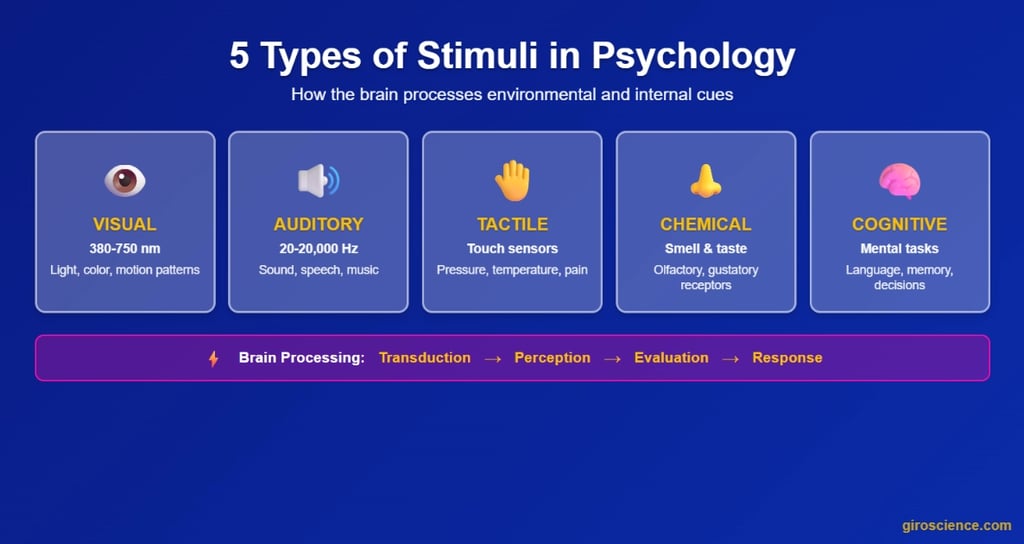
Types of Stimuli by Sensory Modality
Visual Stimuli
Visual stimuli engage electromagnetic radiation (380-750 nanometers):
Spatial patterns: Gratings, shapes testing contrast sensitivity
Color variations: Hue, saturation, brightness
Motion: Direction, speed, coherence
Temporal dynamics: Flicker, onset/offset transients
Vision dominates human sensory processing (~80% of environmental information).
Auditory Stimuli
Auditory stimuli activate pressure wave variations (20-20,000 Hz):
Pure tones: Specific frequencies for audiometry
Speech: Phonemes, words, sentences for language testing
Music: Melodies, rhythms for emotional responses
Noise: White noise, pink noise for masking
Excellent temporal resolution (humans detect <10 ms timing differences).
Tactile and Somatosensory Stimuli
Engage mechanoreceptors, thermoreceptors, nociceptors:
Pressure: Von Frey filaments measuring detection thresholds
Vibration: 2-500 Hz stimulation
Temperature: Heat/cold probes (TRPV and TRPM8 receptors)
Texture: Roughness, compliance testing
Proprioception: Position and movement awareness
Chemical Stimuli
Olfactory: ~400 receptor types detecting volatile molecules. Olfactory dysfunction is an early Alzheimer's/Parkinson's biomarker.
Gustatory: Five basic tastes:
Sweet (carbohydrate detection)
Salty (electrolyte monitoring)
Sour (acidity detection)
Bitter (toxin avoidance)
Umami (protein detection)
Cognitive Stimuli
Engage higher-order processes:
Linguistic: Words, sentences, narratives
Numerical: Math problems, sequences
Logical: Syllogisms, analogies
Memory tasks: Word lists, spatial locations
Decision scenarios: Choices varying in risk, reward, delay
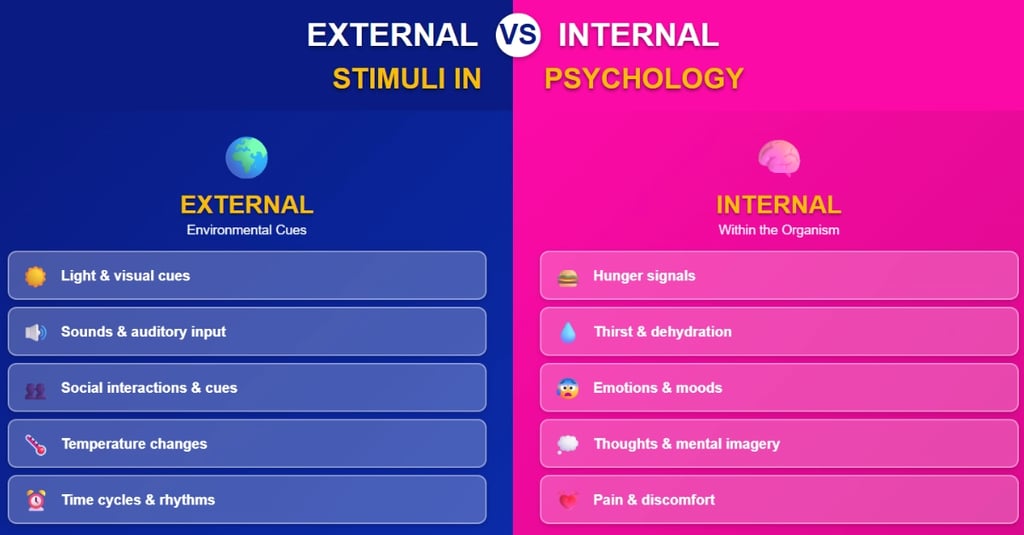
External vs Internal Stimuli
External Stimuli (Environmental)
Originate from physical or social environment:
Physical: Light, sound, temperature, chemicals
Social: Facial expressions, body language, communication
Temporal: Circadian rhythms from light-dark cycles
Spatial: Gravitational cues from vestibular system
Internal Stimuli (Physiological/Psychological)
Originate within the body:
Homeostatic signals: Hunger (ghrelin, blood glucose), thirst (osmolality, blood volume), temperature regulation
Interoceptive signals: Heart rate, breathing, gut sensations
Pain: Tissue damage, inflammation, chronic sensitization
Emotional states: Anxiety, excitement, sadness affecting cognition
Thoughts: Self-generated mental content, rumination
Proprioception: Body position and movement awareness
The distinction matters for understanding self-generated versus environmentally-driven behavior and guides different therapeutic approaches.
Unconditioned, Conditioned & Discriminative Stimuli
Unconditioned Stimuli (US)
Automatically trigger innate responses without learning:
Food: Elicits salivation, digestive secretions
Loud noises: Produce startle reflex, autonomic arousal
Pain: Triggers withdrawal, fear learning
Sexual stimuli: Activate arousal and reproductive behaviors
Engage phylogenetically old brain circuits (brainstem, hypothalamus, amygdala).
Conditioned Stimuli (CS)
Acquire response-eliciting properties through learning:
Pavlovian conditioning: Bell paired with food becomes conditioned stimulus
Fear conditioning: Neutral location associated with trauma becomes fear stimulus (PTSD)
Evaluative conditioning: Brand logos paired with positive emotions influence purchasing
Extinction reduces conditioned responses but doesn't erase original learning.
Discriminative Stimuli
Signal response-outcome relationships:
Green traffic light: Signals safe crossing
"Sale" signs: Signal purchasing opportunity
Facial expressions: Signal social approach/avoidance
Contextual cues: Time, location signaling when behaviors work
Don't elicit automatic responses but set occasion for voluntary behaviors through learned associations.
Stimulus Characteristics Affecting Responses
Intensity
Physical strength. Louder sounds, brighter lights produce larger neural responses following psychophysical laws:
Weber-Fechner Law: Perceived magnitude increases logarithmically with physical intensity
Stevens' Power Law: Perceived magnitude equals intensity raised to modality-specific exponent
Duration
Temporal extent:
Brief stimuli (<50 ms): Activate transient responses
Sustained stimuli: Produce adaptation over time
Frequency
Rate of presentation:
Temporal summation: Rapid trains (>10 Hz) produce larger responses
Fusion thresholds: ~60 Hz for vision, ~1000 Hz for audition
Salience
Novelty or biological significance:
Novelty: Unexpected stimuli capture attention automatically
Biological significance: Reward/danger stimuli activate arousal systems (locus coeruleus, ventral tegmental area, amygdala)
Complexity
Feature number and relationships:
Simple stimuli: Pure tones, uniform colors activate narrow neural populations
Complex stimuli: Faces, speech recruit distributed networks
How Researchers Measure Stimulus Responses
Behavioral Measures
Reaction time: Milliseconds from stimulus to response
Accuracy rates: Percentage correct in tasks
Response bias: Signal detection theory parameters (d-prime, criterion β)
Eye movements: Saccades, fixations revealing attention allocation
Physiological Measures
EEG: Event-related potentials (P300, N400, error-related negativity)
fMRI: Brain activation patterns (2-3 mm spatial resolution)
Pupillometry: Cognitive load and arousal (300-500 ms response)
Heart rate variability: Autonomic balance and emotion regulation
Electrodermal activity: Sympathetic activation (1-3 s latency)
Facial EMG: Subtle emotional responses
Self-Report Measures
Likert scales: Numerical ratings (1-7, 1-9)
Semantic differential: Bipolar adjective pairs
Visual analog scales: Continuous line marking
Magnitude estimation: Proportional number assignment
Computational Approaches
Machine learning: Pattern detection in multivariate responses
Sensor fusion: Integrating multiple data streams
Voice biomarkers: 100-300 acoustic/linguistic features achieving 80-93% accuracy detecting cognitive impairment
Real-World Applications
Clinical Psychology
Exposure therapy: Systematic fear stimulus presentation produces extinction
Cognitive behavioral therapy: Modifying stimulus interpretation patterns
Diagnostic assessment: Standardized stimuli test cognitive functions
Pharmacology: Medications alter stimulus-response relationships
Neuroscience Research
Brain mapping: fMRI/PET localize functions to brain regions
Neural plasticity: Stimulus exposure reorganizes cortical maps
Developmental studies: Infant responses reveal pre-verbal capabilities
Marketing
Advertising design: Eye-tracking optimizes visual attention
Product testing: Physiological/self-report responses predict preferences
Pricing perception: Price stimuli influence perceived quality
Digital Health
Voice biomarkers: Speech stimuli detect cognitive decline 3+ years before diagnosis
Wearable sensors: Continuous physiological monitoring tracks environmental responses
Smartphone phenotyping: Digital behavior reveals health changes
See our guide on voice biomarkers for cognitive decline.
Frequently Asked Questions
What is a stimulus in psychology?
A stimulus in psychology is any detectable change in the environment (external) or within an organism (internal) that triggers a measurable response. Stimuli can be categorized by sensory modality (visual, auditory, tactile, olfactory, gustatory, cognitive), origin (external vs internal), and conditioning status (unconditioned, conditioned, discriminative). Modern neuroscience recognizes complex multi-stage processing transforming physical energy into perceptual experience.
What is the difference between external and internal stimuli?
External stimuli originate from the environment (lights, sounds, social cues, temperature) and engage exteroceptive sensory systems. Internal stimuli originate within the organism (hunger, thirst, pain, emotions, thoughts, interoception) and provide awareness of bodily states. The distinction guides therapeutic approaches:external stressors versus internal dysregulation require different interventions.
What are unconditioned vs conditioned stimuli?
Unconditioned stimuli automatically trigger innate responses without learning (food → salivation, pain → withdrawal). Conditioned stimuli acquire response-eliciting properties through associative learning (Pavlov's bell → salivation after pairing with food). Unconditioned responses reflect hardwired circuits; conditioned responses demonstrate learned predictions enabling environmental adaptation.
How does the brain process stimuli?
Five stages: (1) Sensory transduction converts physical energy to neural signals; (2) Neural transmission through peripheral nerves to thalamus; (3) Primary cortical processing in topographic maps; (4) Higher-order processing in association cortices; (5) Cognitive integration combining sensation with memory, emotion, goals before generating responses. Perception is active construction:the brain predicts incoming stimuli and resolves prediction-input discrepancies.
What characteristics affect stimulus responses?
Five key dimensions: (1) Intensity:physical strength following psychophysical laws; (2) Duration:temporal extent affecting adaptation; (3) Frequency:rate producing summation or fusion; (4) Salience:novelty/significance capturing attention; (5) Complexity:feature number recruiting narrow or distributed networks. Understanding these enables experimental control and response prediction.
How do researchers measure responses?
Three approaches: (1) Behavioral measures (reaction time, accuracy, eye movements); (2) Physiological measures (EEG, fMRI, pupillometry, heart rate, skin conductance, facial EMG); (3) Self-report measures (Likert scales, semantic differentials). Modern computational methods use machine learning and sensor fusion, with voice biomarkers extracting 100-300 features achieving high accuracy detecting cognitive changes.
Sources & Methodology
This guide synthesizes peer-reviewed psychology and neuroscience literature from PubMed, PsycINFO, and Google Scholar (1900-2026).
Key References
Pavlov IP (1927). Conditioned Reflexes. Oxford University Press.
Skinner BF (1938). The Behavior of Organisms. Appleton-Century-Crofts.
Kandel ER, et al. (2013). Principles of Neural Science, 5th Ed. McGraw-Hill.
Goldstein EB (2023). Sensation and Perception, 11th Ed. Cengage Learning.