


Executive Summary
Specific heat capacity is the amount of heat energy required to raise the temperature of one gram of a substance by one degree Celsius (or one kelvin), measured in joules per gram per degree Celsius (J/g°C). The key concept: specific heat capacity determines how much a material's temperature changes when it absorbs or releases heat energy, making it fundamental for thermal management in spacecraft, energy storage systems, and climate science. Materials with high specific heat capacity (like water at 4.18 J/g°C) resist temperature changes and store large amounts of thermal energy, while materials with low specific heat capacity (like metals) heat up and cool down quickly.
The specific heat capacity formula Q = mcΔT relates heat transfer (Q) to mass (m), specific heat capacity (c), and temperature change (ΔT). This equation allows engineers to calculate energy requirements for heating or cooling processes, design thermal control systems for satellites, and optimize phase change materials for energy storage. Water's exceptionally high specific heat capacity moderates Earth's climate and makes it ideal for cooling systems in electronics and spacecraft.
Understanding specific heat capacity is essential for aerospace engineering, materials science, thermodynamics applications, and designing systems that must maintain precise temperature control in extreme environments from deep space to Earth's surface.
Table of Contents
1. What is Specific Heat Capacity?
Specific heat capacity (also called specific heat) is an intensive property that measures how much heat energy a substance requires to increase its temperature. Formally, it is the heat energy needed to raise the temperature of one unit mass of a substance by one degree. Different materials have vastly different specific heat capacities, explaining why water takes much longer to heat than a metal pan on the same stove.
Units Explained: J/g°C and J/kg·K
Specific heat capacity is commonly expressed in two unit systems:
SI units: Joules per kilogram per kelvin (J/kg·K)
Used in scientific literature and engineering
Example: Water has specific heat capacity 4,180 J/kg·K
Common chemistry units: Joules per gram per degree Celsius (J/g°C)
More convenient for laboratory calculations
Example: Water has specific heat capacity 4.18 J/g°C
These units are numerically equivalent when converting between Celsius and Kelvin (since a 1°C change equals a 1 K change). The choice depends on the field and calculation requirements. This guide primarily uses J/g°C for simplicity, but the concepts apply equally to both systems.
Physical Meaning
Specific heat capacity reflects the molecular structure and bonding in materials. Substances with strong intermolecular forces or complex molecular structures generally have higher specific heat capacities because energy distributes across more vibrational modes and bonds.
Water's high specific heat (4.18 J/g°C) results from hydrogen bonding between molecules. Energy absorbed doesn't just increase molecular motion - it also breaks and reforms hydrogen bonds, requiring substantial energy input for temperature change.
Metals' low specific heat (typically 0.1-0.5 J/g°C) occurs because metallic bonding allows rapid energy transfer through the electron sea, and simple atomic structures have fewer energy storage modes.
This property has profound implications. Coastal regions experience milder temperatures than inland areas because large water bodies absorb and release heat slowly, moderating climate. Conversely, desert sand (low specific heat) experiences extreme day-night temperature swings.
2. Specific Heat Capacity Formula
The Basic Equation
The fundamental relationship between heat transfer and temperature change is:
Q = mcΔT
Where:
Q = heat energy transferred (joules, J)
m = mass of substance (grams, g)
c = specific heat capacity (J/g°C)
ΔT = temperature change (°C or K)
This equation can be rearranged to solve for any variable:
c = Q / (mΔT) - to find specific heat capacity
ΔT = Q / (mc) - to find temperature change
m = Q / (cΔT) - to find mass
Calculating Heat Transfer
Example 1: Heating water
How much energy is needed to heat 100 g of water from 20°C to 80°C?
Given:
m = 100 g
c = 4.18 J/g°C (specific heat of water)
ΔT = 80°C - 20°C = 60°C
Calculate: Q = mcΔT Q = (100 g)(4.18 J/g°C)(60°C) Q = 25,080 J = 25.08 kJ
Answer: 25,080 joules or 25.08 kilojoules of energy required.
Worked Examples
Example 2: Cooling aluminum
An aluminum block (c = 0.90 J/g°C) with mass 500 g cools from 200°C to 50°C. How much heat energy is released?
ΔT = 50°C - 200°C = -150°C (negative indicates cooling)
Q = mcΔT Q = (500 g)(0.90 J/g°C)(-150°C) Q = -67,500 J = -67.5 kJ
The negative sign indicates energy is released (exothermic process).
Answer: 67,500 joules of heat energy is released to the surroundings.
3. Specific Heat vs Heat Capacity
Key Differences
These related terms are often confused but have distinct meanings:
Specific Heat Capacity (c):
Intensive property (independent of amount)
Units: J/g°C or J/kg·K
Definition: Heat per unit mass per degree
Example: Water's c = 4.18 J/g°C regardless of amount
Heat Capacity (C):
Extensive property (depends on amount)
Units: J/°C or J/K
Definition: Total heat per degree for entire object
Example: 100 g water has C = 418 J/°C
Relationship: Heat capacity = mass × specific heat capacity C = mc
When to Use Each
Use specific heat capacity (c) when:
Comparing different materials regardless of mass
Looking up values in reference tables
Calculating with the Q = mcΔT formula
Discussing material properties
Use heat capacity (C) when:
Analyzing a specific object or system
The mass is constant and incorporated
Working with calorimetry where total system capacity matters
Example: A spacecraft thermal system uses aluminum panels. The specific heat of aluminum (0.90 J/g°C) is a material property. The heat capacity of a 5 kg panel (4,500 J/°C) describes that specific panel's thermal behavior.
4. Common Specific Heat Values
Liquids
Water: 4.18 J/g°C
Highest of common substances
Critical for climate regulation
Ideal coolant for thermal management
Ethanol: 2.44 J/g°C
Lower than water, still relatively high
Used in thermometers and heat transfer fluids
Mercury: 0.14 J/g°C
Very low for a liquid
Rapid temperature response
Historical use in thermometers
Metals
Aluminum: 0.90 J/g°C
Excellent for heat sinks
Lightweight thermal management
Common in aerospace applications
Copper: 0.39 J/g°C
Lower than aluminum
Superior thermal conductor
Used in electronics cooling
Iron/Steel: 0.45 J/g°C
Moderate specific heat
Structural applications
Cookware material
Gold: 0.13 J/g°C
Very low specific heat
Heats quickly
Electronic connectors
Gases (at constant pressure)
Air: 1.01 J/g°C
Moderate value
Environmental applications
HVAC system design
Helium: 5.19 J/g°C
Highest among gases
Inert coolant properties
Cryogenic applications
Hydrogen: 14.3 J/g°C
Extremely high value
Rocket propellant considerations
Energy storage research
Why Values Differ
Material structure determines specific heat capacity:
Molecular complexity: More atoms and bonds provide more ways to store energy
Intermolecular forces: Stronger attractions require energy to overcome
Phase: Gases generally have higher specific heats than liquids or solids of the same substance
Temperature: Specific heat can vary with temperature, though often assumed constant for small ranges
5. How to Calculate Specific Heat Capacity
Using Temperature Change
When you know the heat added, mass, and temperature change, calculate specific heat:
c = Q / (mΔT)
Problem: A 250 g metal sample absorbs 5,000 J of heat and its temperature rises from 25°C to 75°C. What is the metal's specific heat capacity?
Given:
Q = 5,000 J
m = 250 g
ΔT = 75°C - 25°C = 50°C
Calculate: c = Q / (mΔT) c = 5,000 J / (250 g × 50°C) c = 5,000 J / 12,500 g°C c = 0.40 J/g°C
Answer: The specific heat capacity is 0.40 J/g°C, indicating this is likely iron or steel.
Calorimetry Method
Calorimetry experimentally determines specific heat by measuring heat transfer between objects in an insulated container.
Principle: Heat lost by hot object = Heat gained by cold object m₁c₁ΔT₁ = -m₂c₂ΔT₂
Experiment: A 100 g aluminum sample (c = 0.90 J/g°C) at 100°C is placed in 200 g water (c = 4.18 J/g°C) at 20°C. Final temperature is 24.5°C. Verify the aluminum's specific heat.
For aluminum (cooling): ΔT₁ = 24.5°C - 100°C = -75.5°C For water (heating): ΔT₂ = 24.5°C - 20°C = 4.5°C
Heat lost by aluminum: Q₁ = (100 g)(0.90 J/g°C)(-75.5°C) = -6,795 J
Heat gained by water: Q₂ = (200 g)(4.18 J/g°C)(4.5°C) = 3,762 J
The difference (6,795 J vs 3,762 J) represents heat lost to surroundings, showing why calorimeters must be well-insulated for accurate measurements.
Step-by-Step Examples
Problem: How much energy is required to heat 2 kg of air from 0°C to 100°C?
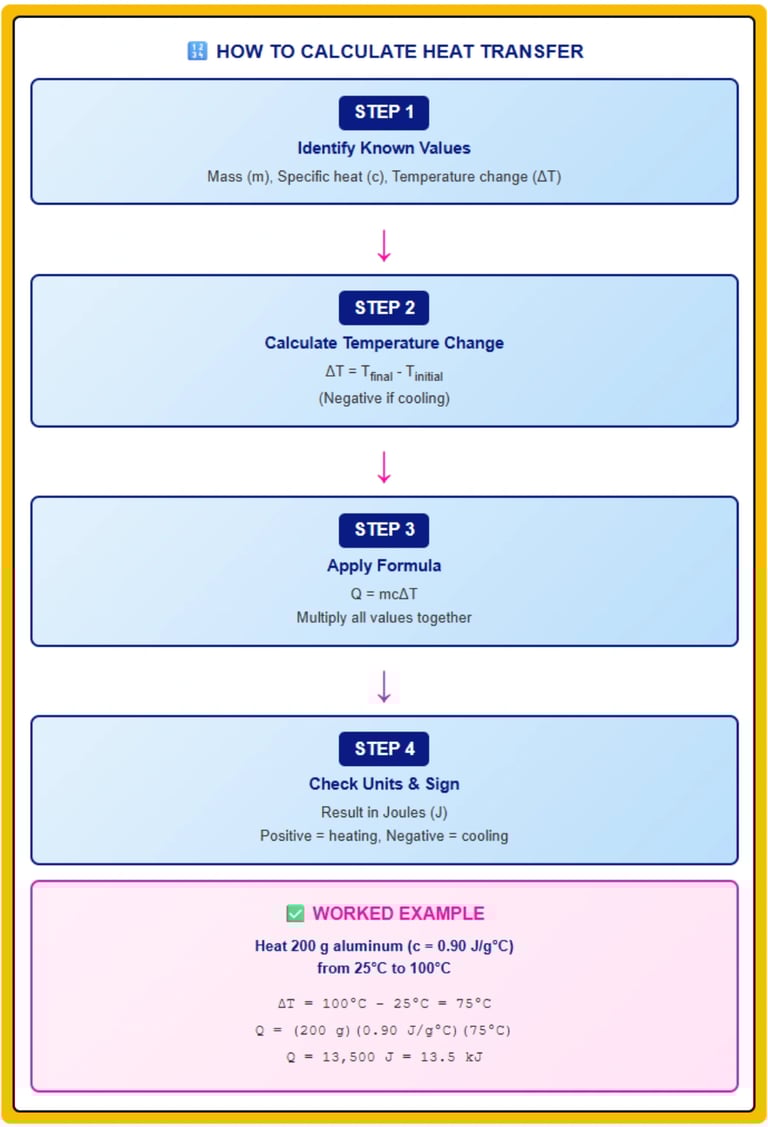
Step 1: Identify known values
m = 2 kg = 2,000 g
c = 1.01 J/g°C (air)
ΔT = 100°C - 0°C = 100°C
Step 2: Apply formula Q = mcΔT
Step 3: Calculate Q = (2,000 g)(1.01 J/g°C)(100°C) Q = 202,000 J = 202 kJ
Step 4: Check units J = (g)(J/g°C)(°C) ✓ Units cancel correctly
Answer: 202 kilojoules of energy required.
6. Applications in Materials Science
Thermal Management Systems
Electronic devices generate heat during operation. Engineers select materials with appropriate specific heat capacities to manage thermal loads. Heat sinks use aluminum (c = 0.90 J/g°C) because its low specific heat means small temperature rises effectively transfer heat away from sensitive components. The heat sink's large surface area then dissipates this energy to surrounding air.
Thermal interface materials between processors and heat sinks must conduct heat efficiently while having appropriate thermal mass. Silver-based compounds offer excellent thermal conductivity, while their low specific heat prevents them from acting as heat storage that could cause temperature spikes during variable loads.
Spacecraft Design
Space presents unique thermal challenges with extreme temperature swings between sunlight (+120°C) and shadow (-150°C). Spacecraft thermal control systems exploit specific heat capacity principles to maintain stable internal temperatures.
Passive thermal control:
Multi-layer insulation (MLI): Low specific heat materials in thin layers minimize heat transfer
Thermal mass: High specific heat materials absorb excess heat during peak solar exposure and release it during eclipse periods
Radiators: Low specific heat panels rapidly release accumulated heat to space via thermal radiation
Active thermal control:
Heat pipes: Working fluids with specific heat properties transfer heat from hot to cold regions
Phase change materials (PCMs): Materials like paraffin wax absorb large amounts of energy during melting (latent heat) while maintaining constant temperature, complementing specific heat-based thermal storage
The International Space Station uses ammonia (c = 4.70 J/g°C) in external cooling loops because its high specific heat efficiently transports thermal energy from interior systems to external radiators.
Energy Storage
Thermal energy storage systems for renewable energy applications select materials based on specific heat capacity and cost.
Sensible heat storage relies directly on specific heat:
Water tanks: High specific heat (4.18 J/g°C) and low cost make water ideal for storing solar thermal energy in residential and commercial systems
Molten salt: Mixtures of sodium and potassium nitrate (c ≈ 1.5 J/g°C) operate at high temperatures (300-600°C) for concentrated solar power plants, storing energy to generate electricity after sunset
Comparison: To store the same energy with a 50°C temperature change:
Water (4.18 J/g°C): 1,000 kg stores 209 MJ
Molten salt (1.5 J/g°C): 2,787 kg stores 209 MJ
Aluminum (0.90 J/g°C): 4,644 kg stores 209 MJ
Water's superior specific heat capacity dramatically reduces system mass and volume.
Climate Science
Earth's climate stability depends fundamentally on water's high specific heat capacity. Oceans cover 71% of Earth's surface and store enormous thermal energy with minimal temperature change.
Ocean thermal inertia: During summer, oceans absorb solar radiation with small temperature increases due to high specific heat. This stored energy releases slowly in winter, moderating seasonal temperature extremes. Coastal regions experience milder climates than continental interiors at the same latitude because water's specific heat buffers temperature changes.
Heat distribution: Ocean currents transport thermal energy globally. The Gulf Stream carries warm water (high energy content due to specific heat) from the tropics to northern Europe, making northwestern Europe significantly warmer than equivalent latitudes in North America.
Climate modeling: Accurate climate predictions require precise specific heat capacity values for ocean layers at different temperatures and salinities. Small errors in specific heat parameters compound over time in models, affecting long-term climate projections.
7. Common Mistakes to Avoid
Mistake 1: Confusing Specific Heat with Heat Capacity
Problem: Using heat capacity (C) values when specific heat capacity (c) is needed, or vice versa.
Example error: "The heat capacity of aluminum is 0.90 J/°C" (Wrong - this is specific heat) Correct: "The specific heat capacity of aluminum is 0.90 J/g°C"
Solution: Remember specific heat is per unit mass (J/g°C), while heat capacity is total for the object (J/°C). Always include mass units (g or kg) in specific heat capacity.
Mistake 2: Forgetting Temperature is Change, Not Final Value
Problem: Using final temperature instead of temperature change (ΔT) in calculations.
Wrong: Q = mc(T_final) for heating from 20°C to 80°C Correct: Q = mc(ΔT) where ΔT = 80°C - 20°C = 60°C
Solution: Always calculate ΔT = T_final - T_initial before substituting into the equation. The delta symbol (Δ) explicitly means "change in."
Mistake 3: Sign Errors in Heat Transfer
Problem: Not recognizing that heat released has negative Q value.
Example: Object cooling from 100°C to 50°C
ΔT = 50°C - 100°C = -50°C
Q = mcΔT will be negative
Correct interpretation: Negative Q means heat flows out of the system (exothermic). Positive Q means heat flows in (endothermic).
Solution: Keep signs throughout calculation. Don't arbitrarily make values positive. The sign tells you the direction of heat transfer.
Mistake 4: Unit Inconsistency
Problem: Mixing unit systems without conversion.
Wrong: Using m in kg with c in J/g°C Example: Q = (2 kg)(4.18 J/g°C)(50°C) = 418 J (WRONG - off by factor of 1,000)
Correct: Convert to consistent units first
Either: m = 2,000 g with c = 4.18 J/g°C
Or: m = 2 kg with c = 4,180 J/kg°C
Solution: Before calculating, verify all units are compatible. When in doubt, convert everything to base SI units (kg, J, K) or commonly used chemistry units (g, J, °C).
8. FAQ
What is specific heat capacity?
Specific heat capacity is the amount of heat energy required to raise the temperature of one gram (or one kilogram) of a substance by one degree Celsius (or one kelvin). It is an intensive material property measured in joules per gram per degree Celsius (J/g°C) or joules per kilogram per kelvin (J/kg·K). Different materials have different specific heat capacities based on their molecular structure and bonding. Water has one of the highest specific heat capacities at 4.18 J/g°C, meaning it requires significant energy to change temperature, which moderates Earth's climate and makes it ideal for cooling applications. Metals typically have low specific heat capacities (0.1-0.9 J/g°C), causing them to heat and cool quickly. Understanding specific heat capacity is essential for thermal management in spacecraft, energy storage system design, and predicting how materials respond to heating or cooling.
What is the formula for specific heat capacity?
The specific heat capacity formula is Q = mcΔT, where Q is heat energy transferred in joules, m is mass in grams or kilograms, c is specific heat capacity, and ΔT is temperature change. This equation can be rearranged to solve for specific heat: c = Q/(mΔT). For example, if 1,000 J of heat raises 50 g of water by 5°C, the specific heat is c = 1,000 J / (50 g × 5°C) = 4.0 J/g°C. The formula shows that substances with high specific heat capacity require more energy for the same temperature change. Temperature change ΔT always equals final temperature minus initial temperature (T_final - T_initial). When an object cools, ΔT is negative, making Q negative to indicate heat release. This fundamental equation applies to all heating and cooling processes where phase changes do not occur.
What is the difference between specific heat and heat capacity?
Specific heat capacity (c) is an intensive property measured per unit mass (J/g°C), while heat capacity (C) is an extensive property for an entire object (J/°C). Specific heat describes the material itself regardless of amount, making it useful for comparing different substances. Heat capacity describes a particular sample and depends on its mass. The relationship is C = mc, where C is heat capacity, m is mass, and c is specific heat capacity. For example, water has a specific heat of 4.18 J/g°C whether you have 1 gram or 1 kilogram. However, 100 g of water has a heat capacity of 418 J/°C (100 g × 4.18 J/g°C). Use specific heat when comparing materials or looking up reference values. Use heat capacity when analyzing a specific object's thermal behavior in engineering applications.
Why does water have such a high specific heat capacity?
Water has an exceptionally high specific heat capacity (4.18 J/g°C) due to extensive hydrogen bonding between molecules. When water absorbs heat energy, much of that energy breaks and reforms hydrogen bonds rather than directly increasing molecular kinetic energy and temperature. Each water molecule can form up to four hydrogen bonds with neighboring molecules, creating a network that requires substantial energy input to disrupt. Additionally, water's bent molecular geometry and polar nature allow vibrational and rotational energy storage modes beyond simple translational motion. This high specific heat makes water an excellent temperature buffer in biological systems, climate regulation, and thermal management applications. Oceans absorb and release enormous amounts of solar energy with minimal temperature change, moderating seasonal climate extremes. In organisms, water-based blood and cellular fluids resist rapid temperature fluctuations, maintaining stable internal environments despite external temperature variations.
How do you calculate heat energy using specific heat?
Calculate heat energy using Q = mcΔT, where Q is heat in joules, m is mass in grams, c is specific heat capacity in J/g°C, and ΔT is temperature change in degrees Celsius. Follow these steps: (1) Identify mass (m) of the substance. (2) Look up or determine specific heat capacity (c) from a reference table. (3) Calculate temperature change: ΔT = T_final - T_initial. (4) Multiply m × c × ΔT to find Q. For example, to heat 200 g of aluminum (c = 0.90 J/g°C) from 25°C to 100°C: m = 200 g, c = 0.90 J/g°C, ΔT = 100°C - 25°C = 75°C, so Q = (200 g)(0.90 J/g°C)(75°C) = 13,500 J = 13.5 kJ. If cooling occurs, ΔT will be negative, making Q negative to indicate heat release. Ensure units are consistent: use grams with J/g°C or kilograms with J/kg·K.
What are common specific heat capacity values?
Common specific heat capacity values (in J/g°C) include: Water (4.18) - highest of common substances, ideal for thermal storage and climate moderation; Ethanol (2.44) - used in thermometers; Air (1.01) - important for HVAC design; Aluminum (0.90) - lightweight heat sinks in electronics; Iron/Steel (0.45) - structural and cookware applications; Copper (0.39) - electronics cooling; Mercury (0.14) - rapid temperature response; and Gold (0.13) - minimal thermal mass for electrical contacts. Gases at constant pressure typically have higher values than the same substance as liquid or solid. Hydrogen (14.3 J/g°C) has the highest specific heat among common gases. These values are measured at room temperature and standard pressure; specific heat can vary with temperature and pressure. When designing thermal systems, engineers select materials based on specific heat capacity matched to application requirements - high values for thermal buffering and energy storage, low values for rapid heating/cooling response.
Related Articles
Continue exploring physics, materials science, and thermal engineering:
Molar Mass: Complete Calculation Guide - Calculate molar mass for thermochemistry and heat capacity calculations
Stoichiometry: Complete Guide with Examples - Use mole calculations in thermal energy problems
Polyatomic Ions: Complete List & Guide - Understand ionic compounds in thermal applications
Ionic vs Covalent Bonds: Complete Guide - How bonding affects thermal properties
Sources and References
Specific Heat Capacity - Wikipedia. Definition, values, and thermodynamic principles. Wikipedia article
Heat Capacity - Wikipedia. Relationship between heat capacity and specific heat. Wikipedia article
Thermodynamics - Wikipedia. First law and energy conservation principles. Wikipedia article
Chemistry: The Science in Context - Thomas R. Gilbert, Rein V. Kirss, Natalie Foster, Stacey Lowery Bretz. General chemistry textbook covering thermochemistry, specific heat, and energy transfer. Free PDF
The Role of Industrial Chemistry in Modern Manufacturing - Applications of thermal management and specific heat in materials science and industrial processes. Open Access PDF