
Executive Summary
Noble gases are six chemical elements in Group 18 of the periodic table - helium (He), neon (Ne), argon (Ar), krypton (Kr), xenon (Xe), and radon (Rn) - characterized by complete outer electron shells that make them extremely unreactive under normal conditions. The key concept: noble gases have full valence electron shells (2 electrons for helium, 8 for all others), satisfying the octet rule without forming chemical bonds, making them chemically inert and suitable for applications requiring non-reactive atmospheres. These colorless, odorless gases find widespread use in lighting (neon signs), arc welding (argon shielding), cryogenics (liquid helium), medical imaging (helium MRI), and semiconductor manufacturing.
The term "noble" reflects their reluctance to react with other elements, similar to how historical nobility avoided mixing with common people. While noble gases rarely form compounds, xenon can bond with highly electronegative elements like fluorine and oxygen under specific conditions. Physical properties vary systematically down the group: atomic size, density, and boiling point increase from helium to radon, while all remain gases at room temperature except radon which is radioactive.
This guide provides comprehensive coverage of noble gas properties, individual element characteristics, electron configurations, and real-world applications in materials science, industry, and technology.
Table of Contents
1. What are Noble Gases?
Noble gases are the six elements in Group 18 (formerly Group VIII or Group 0) of the periodic table, occupying the rightmost column. These elements - helium, neon, argon, krypton, xenon, and radon - share the common characteristic of having completely filled outer electron shells, making them extraordinarily stable and chemically unreactive.
The Six Noble Gases
Helium (He) - Atomic number 2, lightest noble gas, second most abundant element in the universe after hydrogen
Neon (Ne) - Atomic number 10, famous for vibrant red-orange glow in discharge tubes
Argon (Ar) - Atomic number 18, most abundant noble gas in Earth's atmosphere (0.93% by volume)
Krypton (Kr) - Atomic number 36, used in high-performance lighting and lasers
Xenon (Xe) - Atomic number 54, heaviest stable noble gas, forms some compounds
Radon (Rn) - Atomic number 86, only radioactive noble gas, product of uranium and thorium decay
Position on Periodic Table
Noble gases occupy Group 18, the final column on the right side of the periodic table. This position reflects their complete electron shells - they have achieved the most stable electron configuration possible for their respective periods. Each noble gas represents the end point of a period, with the following element starting a new period by beginning to fill the next electron shell.
The vertical arrangement shows clear periodic trends: atomic radius increases down the group, as does atomic mass and density. However, all share the fundamental property of electron shell completion that defines noble gas behavior.
Why Called "Noble"
The term "noble" was chosen because these gases rarely interact with other elements, analogous to how historical nobility remained aloof from commoners. Just as nobles maintained their status by avoiding mixing with lower social classes, noble gases maintain their stability by avoiding chemical bonds with other elements.
This designation appeared in the early 20th century as chemists recognized these elements' extreme chemical inertness. The naming parallels "noble metals" like gold and platinum, which resist corrosion and reaction. In both cases, "noble" denotes chemical stability and resistance to combination with other substances.
2. Electron Configuration and Reactivity
The extraordinary chemical stability of noble gases stems directly from their electron configurations. Understanding why these elements resist bonding requires examining how electrons arrange themselves in atomic orbitals, similar to how understanding ionic versus covalent bonding requires knowledge of electron transfer and sharing between atoms.
Full Outer Electron Shells
Each noble gas has a completely filled outermost electron shell:
Helium (He): 1s² - Two electrons fill the first shell (K shell) completely. This represents the simplest possible stable configuration.
Neon (Ne): 1s² 2s² 2p⁶ - Eight electrons in the second shell (L shell). This configuration became known as the "neon core" when describing heavier elements.
Argon (Ar): 1s² 2s² 2p⁶ 3s² 3p⁶ - Eight electrons in the third shell (M shell), though this shell can hold up to 18 electrons in transition metals.
Krypton (Kr): [Ar] 4s² 3d¹⁰ 4p⁶ - Eight electrons in the fourth shell outermost subshells.
Xenon (Xe): [Kr] 5s² 4d¹⁰ 5p⁶ - Eight electrons in the fifth shell outermost subshells.
Radon (Rn): [Xe] 6s² 4f¹⁴ 5d¹⁰ 6p⁶ - Eight electrons in the sixth shell outermost subshells.
Octet Rule Satisfaction
The octet rule states that atoms tend to gain, lose, or share electrons to achieve eight electrons in their valence (outermost) shell, matching the electron configuration of the nearest noble gas. Noble gases already possess this stable configuration naturally - they don't need to react to achieve it.
Helium is the exception with only two valence electrons, but this completely fills its first shell, making it equally stable. The "duet rule" applies to helium - two electrons provide the same stability for the first shell that eight electrons provide for subsequent shells.
This pre-existing stability explains why noble gases have extremely low chemical reactivity. Other elements react specifically to achieve noble gas electron configurations - noble gases have already achieved this ideal state.
Why They Don't Bond
Chemical bonding occurs when atoms can lower their total energy by sharing or transferring electrons. For most elements, forming bonds releases energy because achieving a stable electron configuration (typically eight valence electrons) creates a lower-energy, more stable state.
Noble gases already exist in this lowest-energy electron configuration. Removing electrons requires substantial energy input to overcome the stable filled shell. Adding electrons is equally unfavorable because it would place them in a new, higher-energy shell. Sharing electrons offers no energy advantage since the stable configuration already exists.
The energy cost of disturbing a noble gas's electron configuration exceeds any potential energy benefit from forming chemical bonds under normal conditions, much like how calculating molar mass requires understanding stable atomic configurations from the periodic table.
Exceptions: Noble Gas Compounds
While noble gases are generally unreactive, xenon and krypton can form compounds with highly electronegative elements under specific conditions:
Xenon compounds: XeF₂, XeF₄, XeF₆ (xenon fluorides), XeO₃, XeO₄ (xenon oxides), and XeOF₄. These form because fluorine and oxygen are electronegative enough to pull electrons from xenon's filled 5p orbital.
Krypton compounds: KrF₂ (krypton difluoride) is the primary known krypton compound, stable only at low temperatures.
Radon compounds: Several radon fluorides theoretically exist, though radon's radioactivity makes experimental study difficult.
Helium, neon, and argon have never been observed to form stable chemical compounds. Their smaller atomic sizes and higher ionization energies make electron removal energetically prohibitive even with highly electronegative partners.
3. Physical Properties
Noble gases share several characteristic physical properties that result from their atomic structure and weak interatomic forces.
Colorless and Odorless
All noble gases are colorless, odorless, and tasteless under normal conditions. This absence of sensory properties stems from their monatomic nature and lack of chemical reactivity. Unlike molecules that can absorb visible light (producing color) or interact with olfactory receptors (producing odor), individual noble gas atoms simply don't interact strongly enough with light or biological sensors to produce detectable sensory responses.
In discharge tubes, noble gases emit characteristic colors when electrical energy excites their electrons: helium produces pale yellow to peach, neon gives bright red-orange, argon shows violet-blue, krypton displays white to pale yellow, and xenon emits blue-white light. These colors result from electron transitions, not inherent atomic color.
Low Boiling and Melting Points
Noble gases have exceptionally low boiling and melting points compared to elements of similar atomic mass. This reflects weak interatomic forces - only London dispersion forces (temporary induced dipoles) hold noble gas atoms together in liquid or solid states.
Boiling points (at 1 atm):
Helium: -268.9°C (4.2 K) - lowest boiling point of any element
Neon: -246.1°C (27.1 K)
Argon: -185.8°C (87.3 K)
Krypton: -153.4°C (119.9 K)
Xenon: -108.1°C (165.0 K)
Radon: -61.7°C (211.5 K)
The trend shows increasing boiling points down the group. Larger atoms have more electrons, creating stronger London dispersion forces through larger temporary dipoles.
Melting points follow similar trends but at slightly lower temperatures. Helium remains liquid down to absolute zero at normal pressure - it requires increased pressure to solidify.
Density and Atomic Mass Trends
Both density and atomic mass increase systematically down Group 18:
Atomic masses:
Helium: 4.00 u
Neon: 20.18 u
Argon: 39.95 u
Krypton: 83.80 u
Xenon: 131.29 u
Radon: 222 u (most stable isotope)
Gas densities (at STP):
Helium: 0.18 g/L - lighter than air, rises
Neon: 0.90 g/L - lighter than air
Argon: 1.78 g/L - heavier than air (air = 1.29 g/L)
Krypton: 3.74 g/L - significantly heavier than air
Xenon: 5.89 g/L - over 4× denser than air
Radon: 9.73 g/L - densest noble gas
This density variation affects applications - helium lifts balloons while argon provides dense shielding in arc welding.
Solubility in Water
Noble gases are sparingly soluble in water, with solubility increasing down the group. This trend reflects increasing atomic size and polarizability:
Helium: 0.0015 g/100 mL at 20°C
Argon: 0.0034 g/100 mL at 20°C
Xenon: 0.0108 g/100 mL at 20°C
While low, this solubility has biological significance - dissolved nitrogen and helium cause decompression sickness in divers. Xenon's higher solubility contributes to its anesthetic properties.
4. Individual Noble Gases
Helium (He)
Discovery: 1868 (in solar spectrum), 1895 (on Earth)
Abundance: Second most abundant element in the universe, rare on Earth (0.0005% of atmosphere)
Key properties: Lowest boiling point of any element, remains liquid at absolute zero under normal pressure, extremely low density
Applications:
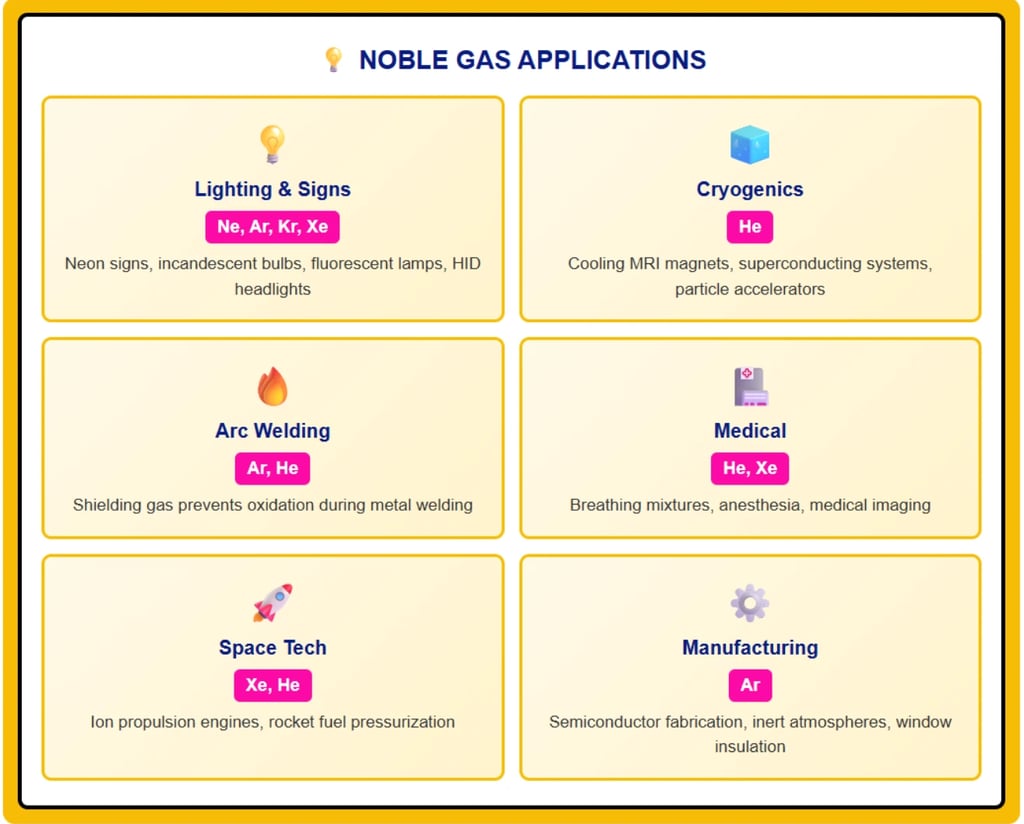
Cryogenics: Cooling superconducting magnets in MRI machines and particle accelerators
Balloons and airships: Non-flammable lifting gas
Arc welding: Inert atmosphere for welding reactive metals
Diving: Mixed with oxygen for deep-sea diving (reduces nitrogen narcosis)
Leak detection: Small atomic size allows helium to penetrate tiny gaps
Production: Extracted from natural gas deposits, particularly in the United States, Qatar, and Algeria. Helium forms from radioactive decay of uranium and thorium in Earth's crust, accumulating in the same geological formations as natural gas.
Neon (Ne)
Discovery: 1898 by William Ramsay and Morris Travers
Abundance: 0.0018% of Earth's atmosphere
Key properties: Bright red-orange glow in discharge tubes, very low liquid range
Applications:
Lighting: Neon signs and advertising displays (actually uses neon for red-orange, other gases for different colors)
Lasers: Helium-neon lasers for alignment, barcode scanning
Cryogenic refrigerant: Neon refrigeration for applications requiring -240°C to -270°C
High-voltage indicators: Neon indicator lamps
Production: Obtained by fractional distillation of liquid air. Neon is separated after nitrogen, oxygen, and argon due to its very low boiling point.
Argon (Ar)
Discovery: 1894 by Lord Rayleigh and William Ramsay
Abundance: 0.93% of Earth's atmosphere - most abundant noble gas in air
Key properties: Dense, inert, readily available
Applications:
Arc welding: Shielding gas prevents oxidation of weld metal, especially for aluminum and stainless steel
Light bulbs: Inert atmosphere prevents tungsten filament oxidation
Semiconductor manufacturing: Inert atmosphere for crystal growth
Document preservation: Argon displaces oxygen to prevent degradation
Wine preservation: Argon blanket prevents oxidation in opened bottles
Production: Industrially separated from air by fractional distillation. Argon's abundance and convenient boiling point make it the cheapest noble gas for commercial use, just as understanding stoichiometric ratios helps optimize industrial chemical processes.
Krypton (Kr)
Discovery: 1898 by William Ramsay and Morris Travers
Abundance: 1 ppm in Earth's atmosphere
Key properties: Bright white light in discharge tubes, forms KrF₂ under extreme conditions
Applications:
High-performance lighting: Krypton-filled bulbs provide brighter, whiter light than argon
Lasers: Krypton ion lasers for scientific and medical applications
Photography: Flash lamps for high-speed photography
Insulation: Krypton-filled windows provide superior thermal insulation
Measurement standard: Krypton-86 wavelength defined the meter from 1960-1983
Production: Fractional distillation of liquid air, separated alongside xenon. Krypton's scarcity makes it significantly more expensive than argon.
Xenon (Xe)
Discovery: 1898 by William Ramsay and Morris Travers
Abundance: 0.09 ppm in Earth's atmosphere
Key properties: Heaviest stable noble gas, forms compounds with fluorine and oxygen, has anesthetic properties
Applications:
Lighting: High-intensity discharge lamps, automotive headlights (HID/xenon headlights), IMAX projectors
Medical: General anesthetic (expensive but rapid-acting with few side effects)
Ion propulsion: Xenon ions provide thrust in spacecraft electric propulsion systems
Nuclear energy: Xenon isotopes used to monitor nuclear reactors
Imaging: Xenon-enhanced CT scans for lung ventilation studies
Production: Fractional distillation of liquid air. Xenon is the rarest non-radioactive noble gas, making it the most expensive for commercial applications.
Radon (Rn)
Discovery: 1900 by Friedrich Ernst Dorn
Abundance: Trace amounts from uranium and thorium decay
Key properties: Only radioactive noble gas, all isotopes unstable, health hazard in buildings
Health concerns: Radon gas accumulating in basements and crawl spaces is the second leading cause of lung cancer after smoking. Radon-222 (half-life 3.8 days) decays into radioactive polonium, lead, and bismuth isotopes that deposit in lung tissue.
Historical applications:
Cancer treatment: Radon seeds once used for radiation therapy (now replaced by safer isotopes)
Earthquake prediction: Radon emission monitoring as possible earthquake precursor
Current use: Primarily limited to research and radiation calibration. Radon's radioactivity and short half-life prevent most practical applications.
5. Applications in Materials Science
Lighting and Lasers
Noble gases revolutionized lighting technology through their ability to emit characteristic colors when electrically excited.
Neon lighting: When electrical current passes through neon gas at low pressure, electrons collide with neon atoms, exciting them to higher energy states. As electrons return to ground states, they emit photons with wavelengths producing the characteristic red-orange glow. Different noble gases produce different colors - argon gives blue-violet, krypton produces pale yellow, xenon emits blue-white.
Fluorescent lighting: Argon-mercury vapor fluorescent lamps use argon as the primary gas with small amounts of mercury vapor. Electrical discharge excites mercury atoms which emit ultraviolet light. Phosphor coating on the tube converts UV to visible light. Argon's low cost makes it ideal for this mass-market application.
High-intensity discharge (HID) lamps: Xenon and metal halide HID lamps produce extremely bright white light for automotive headlights, stadium lighting, and film projection. Xenon's high atomic number produces a spectrum closely matching sunlight.
Lasers: Helium-neon lasers were the first continuous-wave lasers, still widely used for alignment, barcode scanning, and laboratory applications. Argon-ion and krypton-ion lasers produce multiple wavelengths useful in scientific research and medical treatments.
Cryogenics and Cooling
Liquid helium: At 4.2 K (-268.9°C), liquid helium cools superconducting magnets in MRI machines, NMR spectrometers, and particle accelerators like the Large Hadron Collider. Superconducting materials lose all electrical resistance when cooled below critical temperatures, enabling powerful electromagnets that would otherwise overheat.
Helium-3 (rare isotope) achieves even lower temperatures through dilution refrigeration, reaching millikelvins for quantum computing research and fundamental physics experiments.
Neon refrigeration: Liquid neon's temperature range (-246°C to -228°C) fills the gap between liquid hydrogen and liquid helium for specialized cryogenic applications where liquid nitrogen (-196°C) is too warm.
The precise temperature control required in cryogenic systems parallels the careful calculations needed when working with specific heat capacity in thermal engineering applications.
Welding and Manufacturing
Argon shielding gas: Arc welding of reactive metals (aluminum, magnesium, titanium, stainless steel) requires inert atmospheres to prevent oxidation. Argon's density creates a protective blanket over the weld pool, displacing oxygen and nitrogen that would weaken the weld.
TIG (Tungsten Inert Gas) welding uses pure argon or argon-helium mixtures for precision welding of thin materials. MIG (Metal Inert Gas) welding employs argon or argon-CO₂ mixtures for higher-speed production welding.
Helium in welding: While more expensive than argon, helium provides deeper penetration and higher heat input in welding thick aluminum and copper sections. Argon-helium mixtures optimize the benefits of both gases.
Semiconductor manufacturing: Ultrapure argon and nitrogen atmospheres prevent oxidation during silicon crystal growth and wafer processing. Even trace oxygen would create defects in semiconductor devices. The semiconductor industry consumes millions of cubic feet of argon annually.
Medical Applications
MRI cooling: Magnetic Resonance Imaging depends on superconducting magnets producing 1.5-3 Tesla magnetic fields (60,000× Earth's magnetic field). These magnets must operate at liquid helium temperature to maintain superconductivity. A typical MRI machine contains 1,700 liters of liquid helium.
Xenon anesthesia: Xenon acts as an effective general anesthetic through NMDA receptor antagonism. Advantages include rapid onset/recovery, minimal metabolism, and no known toxicity. Disadvantages include high cost (>$1,000 per procedure) limiting widespread use.
Hyperpolarized noble gas MRI: Laser-polarized helium-3 or xenon-129 inhaled by patients enables detailed lung imaging impossible with conventional MRI. This technique visualizes air flow and gas exchange in lung tissue.
Argon plasma coagulation: Medical devices using argon plasma streams cauterize tissue during surgery, providing precise hemostasis (bleeding control) in gastrointestinal and other procedures.
6. Industrial and Scientific Uses
Space Exploration
Xenon ion propulsion: Electric propulsion systems ionize xenon and accelerate the ions through electric fields to generate thrust. While providing very low thrust compared to chemical rockets, ion engines operate continuously for months or years, achieving much higher total velocity change (delta-v) with far less propellant mass.
NASA's Dawn spacecraft used xenon ion engines to visit asteroids Vesta and Ceres. SpaceX Starlink satellites use krypton ion thrusters for orbital adjustments. Ion propulsion enables deep-space missions impossible with conventional chemical rockets.
Helium pressurization: Rocket fuel tanks require pressurization to maintain positive pressure feeding propellants to engines. Helium's low density, chemical inertness, and ability to remain gaseous at cryogenic temperatures make it ideal for this application. Both hydrogen-oxygen rockets and kerosene-oxygen rockets use helium pressurization.
Research and Metrology
Particle physics: The Large Hadron Collider uses 96 metric tons of liquid helium to cool superconducting magnets to 1.9 K (-271.3°C), enabling the 16 Tesla magnetic fields that guide particle beams around the 27-kilometer ring.
Nuclear reactor monitoring: Xenon-135 buildup in nuclear reactors absorbs neutrons, affecting reactor control. Monitoring xenon concentrations helps operators manage reactor power levels safely.
Dating and tracers: Argon-argon dating (measuring decay of potassium-40 to argon-40) determines ages of rocks and minerals millions to billions of years old, refining our understanding of Earth's geological history and asteroid impact timing.
Measurement standards: From 1960 to 1983, the meter was defined as 1,650,763.73 wavelengths of krypton-86 orange-red emission line. Though now defined using the speed of light, this demonstrates noble gases' role in fundamental measurement standards.
Environmental and Safety Applications
Window insulation: Argon and krypton-filled double or triple-pane windows reduce heat transfer better than air-filled gaps. Argon fills the gap in most modern insulating windows, while krypton's higher cost limits it to thin premium windows where superior insulation justifies the expense.
Radon testing: Home radon testing detects dangerous radon accumulation in basements and crawl spaces. Mitigation systems vent radon outdoors before it reaches hazardous concentrations, reducing lung cancer risk.
Fire suppression: While expensive, argon and nitrogen mixtures provide inert-gas fire suppression for server rooms, museums, and archives where water damage from sprinklers would be catastrophic.
The systematic application of noble gases across industries demonstrates how understanding fundamental chemical properties - like those explored in polyatomic ion chemistry - enables technological innovation.
7. Common Mistakes to Avoid
Mistake 1: Assuming All Noble Gases Never Form Compounds
Problem: Believing that noble gas chemical inertness is absolute.
Reality: While helium, neon, and argon have never formed stable compounds, xenon forms numerous compounds with fluorine, oxygen, and other electronegative elements. Krypton forms KrF₂ under specific conditions. The term "inert" is outdated - chemists now prefer "noble" to acknowledge these exceptions.
Examples: XeF₂, XeF₄, XeF₆, XeO₃, XeO₄, XeOF₄, and various xenon salts exist. Xenon compounds have applications in oxidative chemistry and theoretical importance in understanding chemical bonding.
Solution: Recognize that chemical reactivity is not binary. Noble gases are highly unreactive under normal conditions, but extreme conditions or highly electronegative partners enable some compound formation, especially for heavier noble gases.
Mistake 2: Confusing Noble Gases with Inert Atmospheres
Problem: Using "inert" and "noble gas" interchangeably when discussing welding or other industrial processes.
Reality: Many "inert" industrial atmospheres use nitrogen, not noble gases. Nitrogen is much cheaper than argon and sufficiently unreactive for many applications. However, nitrogen reacts with some metals (forming nitrides) at high temperatures, limiting its use where argon is essential.
Examples: Food packaging typically uses nitrogen flushing, not argon. Chemical synthesis requiring truly inert conditions uses argon. Welding of steel can use nitrogen in some cases, while aluminum welding requires argon.
Solution: Distinguish between "inert" (unreactive in specific context) and "noble gas" (Group 18 element). Check whether an application truly requires a noble gas or whether cheaper nitrogen suffices.
Mistake 3: Neglecting Radon Hazards
Problem: Underestimating radon health risks or assuming granite countertops are dangerous radon sources.
Reality: Radon enters buildings primarily through foundation cracks and gaps, not granite countertops. Soil beneath buildings contains uranium and thorium that decay into radon. Buildings with poor ventilation accumulate radon to dangerous levels. The EPA estimates radon causes 21,000 lung cancer deaths annually in the United States.
Misconception clarification: While granite contains trace uranium, the amount of radon released from countertops is negligible compared to soil sources. Focus radon mitigation on foundation sealing and sub-slab ventilation, not countertop removal.
Solution: Test homes for radon, especially basements and ground-level rooms. Install radon mitigation systems if levels exceed 4 pCi/L (EPA action level). Understand that radon is a legitimate concern requiring testing and potential remediation, but focus on actual sources.
Mistake 4: Overlooking Helium Supply Constraints
Problem: Treating helium as an unlimited resource suitable for party balloons and trivial uses.
Reality: Helium is non-renewable on human timescales. Once released to the atmosphere, helium escapes Earth's gravity into space. Global helium reserves are limited and concentrated in a few countries. Helium's importance in MRI machines, particle accelerators, and semiconductor manufacturing far exceeds its value for balloons.
Supply chain issues: Helium shortages periodically affect medical imaging, scientific research, and manufacturing. Prices fluctuate based on supply disruptions and geopolitical factors.
Solution: Recognize helium as a strategic resource. Support helium recycling in research facilities and medical centers. Consider whether applications truly require helium or whether alternatives exist. Reserve helium for critical applications where no substitute works, much like how kinematic equations require specific conditions to apply correctly.
8. FAQ
What are noble gases and why are they called noble?
Noble gases are the six elements in Group 18 of the periodic table: helium (He), neon (Ne), argon (Ar), krypton (Kr), xenon (Xe), and radon (Rn). They are called "noble" because they rarely react with other elements, analogous to how historical nobility avoided mixing with commoners. The term reflects their chemical stability and reluctance to form compounds under normal conditions. Noble gases achieve this stability through complete outer electron shells - helium has 2 electrons filling its first shell, while the others have 8 electrons filling their outermost shell. This electron configuration satisfies the octet rule without requiring chemical bonding. The name "noble" parallels "noble metals" like gold and platinum, which resist corrosion. Early chemists believed noble gases were completely inert, though we now know xenon and krypton can form compounds with highly electronegative elements under specific conditions.
Why are noble gases unreactive?
Noble gases are unreactive because they have completely filled outer electron shells, representing the most stable electron configuration possible for their respective periods. Chemical reactions occur when atoms can lower their total energy by forming bonds through electron sharing or transfer. Noble gases already exist in this lowest-energy state, so bonding offers no energy advantage. Removing electrons from a noble gas requires substantial energy to overcome the stable filled shell - helium has the highest first ionization energy of any element. Adding electrons is equally unfavorable because it would place them in a new, higher-energy shell far from the nucleus. For most elements, achieving eight valence electrons (noble gas configuration) releases energy and drives chemical reactivity. Noble gases already possess this ideal configuration, eliminating the driving force for bonding. The energy cost of disturbing their electron arrangement exceeds any potential benefit from compound formation under normal conditions, making them extraordinarily stable and chemically inert.
What are the main uses of noble gases?
Noble gases have diverse applications across industry, medicine, and research. Helium cools superconducting magnets in MRI machines and particle accelerators, provides non-flammable lift for balloons and airships, and creates inert atmospheres for welding reactive metals. Neon produces the characteristic red-orange glow in advertising signs and indicator lights. Argon serves as inert shielding gas in arc welding, fills light bulbs to prevent filament oxidation, and provides inert atmospheres in semiconductor manufacturing and document preservation. Krypton improves lighting efficiency in high-performance bulbs and insulates premium windows. Xenon enables high-intensity discharge automotive headlights, powers ion propulsion systems on spacecraft, serves as a general anesthetic in medicine, and creates brilliant white light for film projectors. Radon's applications are limited due to radioactivity, though it has historical use in cancer treatment. These applications exploit noble gases' chemical inertness, unique emission spectra, low boiling points, and other distinctive properties unavailable from reactive elements.
Can noble gases form chemical compounds?
Yes, some noble gases can form chemical compounds, though this requires extreme conditions or highly electronegative partners. Xenon forms the most compounds, including xenon fluorides (XeF₂, XeF₄, XeF₆), xenon oxides (XeO₃, XeO₄), and mixed compounds like XeOF₄. Krypton forms krypton difluoride (KrF₂), stable only at low temperatures. Radon theoretically forms radon fluorides, though its radioactivity makes experimental study difficult. These compounds form because fluorine and oxygen are electronegative enough to pull electrons from the filled 5p or 4p orbitals of heavy noble gases. Helium, neon, and argon have never been observed to form stable chemical compounds - their smaller atomic sizes and higher ionization energies make electron removal energetically prohibitive even with the most reactive elements. The existence of noble gas compounds, discovered in 1962, revolutionized chemistry by disproving the long-held belief that these elements were completely inert. Modern chemistry uses "noble" rather than "inert" to acknowledge this reactivity under special conditions.
Which noble gas is most abundant on Earth?
Argon is the most abundant noble gas on Earth, comprising 0.93% of the atmosphere by volume - making it the third most abundant atmospheric gas after nitrogen (78%) and oxygen (21%). This abundance results from radioactive decay of potassium-40 in Earth's crust, continuously producing argon-40 over billions of years. While helium is the second most abundant element in the universe, it is rare on Earth (only 0.0005% of atmosphere) because its low atomic mass allows it to escape Earth's gravity when it reaches the upper atmosphere. Neon ranks second among noble gases in Earth's atmosphere at 0.0018%, followed by helium, krypton (1 ppm), and xenon (0.09 ppm). Radon exists only in trace amounts as a radioactive decay product of uranium and thorium. Argon's abundance makes it the cheapest noble gas for commercial applications - industrial argon costs roughly $0.50 per liter, while xenon costs $100+ per liter. This price difference drives the widespread use of argon in arc welding, lighting, and other mass-market applications where its properties suffice.
Is radon dangerous and where does it come from?
Yes, radon is dangerous - it is the second leading cause of lung cancer after smoking, responsible for approximately 21,000 lung cancer deaths annually in the United States according to EPA estimates. Radon is a colorless, odorless, radioactive noble gas that forms naturally from the decay of uranium-238 and thorium-232 in soil, rock, and water. The decay chain produces radon-222 (half-life 3.8 days), which is gaseous and can migrate through soil into buildings through foundation cracks, gaps around pipes, and porous concrete. Once indoors, radon accumulates to concentrations much higher than outdoor levels, especially in poorly ventilated basements and ground-level rooms. The health hazard arises because radon itself decays into radioactive polonium, lead, and bismuth isotopes that deposit in lung tissue, where their alpha particle emissions damage DNA and cause cancer. Radon levels vary by geography based on underlying geology - areas with granite, shale, or uranium deposits show higher concentrations. The EPA recommends testing all homes and installing mitigation systems if radon exceeds 4 picocuries per liter (pCi/L). Mitigation typically involves sub-slab ventilation systems that draw radon from beneath foundations and vent it outdoors before it enters living spaces.
Related Articles
Continue exploring chemistry, materials science, and periodic table elements:
Ionic vs Covalent Bonds: Complete Guide - Compare bonding types including noble gas electron configurations
Polyatomic Ions: Complete List & Guide - Contrast simple noble gases with complex polyatomic ions
Molar Mass: Complete Calculation Guide - Calculate molar masses including noble gas elements
Stoichiometry: Complete Guide with Examples - Apply stoichiometric principles to noble gas reactions
Specific Heat Capacity: Complete Guide - Thermal properties of elements including noble gases
Kinematic Equations: Complete Physics Guide - Physics applications of noble gases in space propulsion
Sources and References
Noble Gas - Wikipedia. Comprehensive coverage of properties, compounds, and applications. Wikipedia article
Periodic Table - Wikipedia. Position and trends of Group 18 elements. Wikipedia article
Electron Configuration - Wikipedia. Orbital filling and stability principles. Wikipedia article
Chemistry: The Science in Context - Thomas R. Gilbert, Rein V. Kirss, Natalie Foster, Stacey Lowery Bretz. General chemistry textbook covering noble gases, electron configuration, and periodic trends. Free PDF
The Role of Industrial Chemistry in Modern Manufacturing - Applications of noble gases in materials science, welding, and industrial processes. Open Access PDF